We Move the Dates
For us, instability is a scheduling problem. For the people who live there, it’s just where they live.
On the ghats at Pashupatinath, along the Bagmati River in Kathmandu, families have been cremating bundles of grass.
The bundles are effigies made of sacred kusha grass, each one standing in for someone the flood took. A priest tells the mourner to wash it. There are flowers and a clay lamp. The fire does what fires there have always done. The difference is that the body is still somewhere up the Trishuli valley, under the ice, rock and mud that came down when part of a glacier in Langtang National Park collapsed on August 26, or somewhere downriver. More than a thousand people died, thousands more are still missing, and many of them will never be found. So their families burn grass.
Lane is in Nepal right now. They travel full-time, the way Lisa and I do, moving between apartments and hotels. They’ve walked past the ghats and looked long enough to understand what they were seeing. They don’t really look anymore. It’s too intense.
That’s what I keep coming back to. For Lisa and me, and for Lane, instability anywhere in the world is a scheduling problem. We move the dates. We pick another country. We eat a deposit, or we don’t. For the people who live there, it’s where they live.
The past couple of years have given us a lot of practice at moving the dates.
Start with heat, since it shows up in the hotel room. A few summers ago we would have rented a handsome old flat in London with no air conditioning and been fine. Now air conditioning is close to essential there in summer, and the flats we look at that have it cost two or three times what comparable ones without it do. In France this past May, a heat wave made even nice hotel rooms hard to sleep in. In Paris we stayed somewhere very high-end, and the air conditioner lost. In July we were in Barcelona for the start of the Tour de France. We expected heat. We got 100°F, and the hotel’s air conditioning wasn’t close to keeping up. A sign in the room blamed a government limit on how low you could set it. Spain has no such rule for hotel rooms.
Every one of those is a price signal for us. London got expensive, so we’ll skip London in August. The Londoner in a top-floor Victorian flat doesn’t get a price signal. They get the summer.
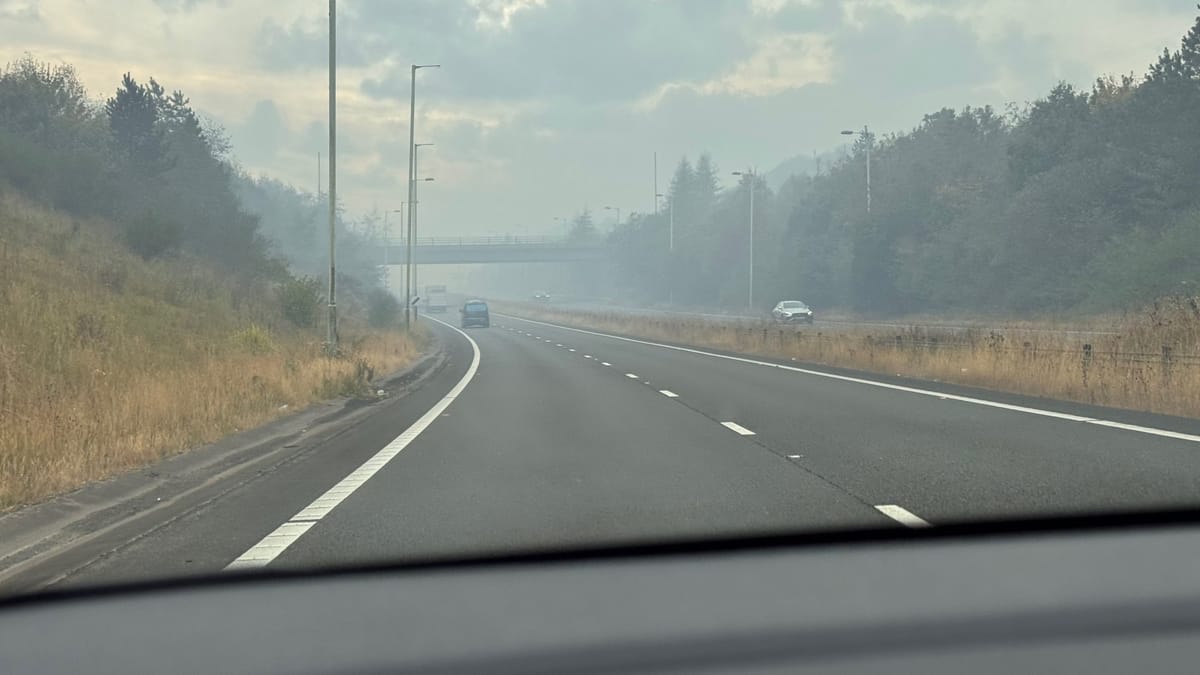
In Wales in August, it came in as smoke. We had a cottage for the month, out in the middle of a national park, and when the wildfires started, the smoke got into the cottage with us. Driving the highways in the middle of the day, we had to turn on our headlights to see through it. For us it was a strange few weeks. For the people who live in those valleys, it’s what the summer is now.
In 2024 we drove through Zimbabwe and Zambia during the drought and watched the crops drying up in the fields along the road, mile after mile. We were looking at it through a car window. The farmers were looking at a year’s food and income, and they can’t move the planting to a better country.
Next summer we’re going to Tromsø, well north of the Arctic Circle, in part because it will be cool. Norway is one of the most expensive places we go. Cool weather used to be free. Now it’s a line item, and we’re paying it.
Then there are the places that closed. We canceled Syria because of the fighting. The same wars took out a cruise that would have carried us from Dubai through the Red Sea and the Suez Canal to Europe. What vanished there was a route rather than a destination. We’re supposed to be in Dubai for New Year’s, so we’re watching it closely. Iran has struck the Emirates this year, along with other Gulf states that host American bases. Fighting has broken out in Tigray again, which pushes a return to Ethiopia, something we’ve talked about for years, further off. We’ve been to Russia twice, and that door is shut for us. I’ve been to Kyiv. Lisa hasn’t, and she really wants to go.
We’ve walked through the aftermath of a lot of wars: First and Second World War sites, Korean War sites, and more recently Iraq and the Green Line that once split Beirut. Armenia was different. We were there in September 2024, a year after Azerbaijan’s lightning offensive took Nagorno-Karabakh, the Armenian-held enclave inside Azerbaijan. Armenia had already lost a war over it in 2020, one in which Azerbaijan’s drones did much of the damage. The country was celebrating its Independence Day while we were there. At some level it was a pep rally, and it was the saddest pep rally I have ever seen. We were guests. Everyone else there was cheering for a country that had just lost Karabakh.
Lisa and I have a running joke about all this, and like most of our running jokes it has stopped being entirely a joke. When we go looking for somewhere stable, somewhere we can count on, our first thought is China.
The quieter shifts rearrange the map too. Currencies swing, and a place that was cheap isn’t, or the reverse; Turkey and Argentina have both moved hard. Mosquito-borne viruses are turning up in places whose clinics were never built for them. There are fuel shortages in parts of Asia. Thailand just cut its visa-free stay for Americans from 60 days to 30, which changes how a person travels there, not just how long. China is going the other way, opening visa-free entry to more and more countries, though Americans still need a visa unless they’re only passing through.
Borders that were supposed to have disappeared are coming back, too. We’ve gone through border checks inside the Schengen area, including between Spain and France, where there normally isn’t a check. The rules let a country reinstate checks temporarily, and several have kept renewing “temporary” for years. Governments justify them on security grounds. In practice they’re aimed mostly at migration. They are politics, showing up at the border.
All of it pushes travelers in one direction. People who get nervous quickly retreat into the safe middle, the historic centers of a handful of European cities, which turn into the Disney World version of themselves under the weight. And when a place gets a reputation for being safe and orderly, the crowd arrives all at once. Japan is the obvious case. A few residents in Barcelona squirting tourists with water pistols make the news, and some of the people who read it book Tokyo instead. The safe middle isn’t all that calm either. In the past two weeks we’ve walked into big protests in Toulouse and in Paris.
The crowd moving is its own kind of instability, and Lane has had a front-row seat twice. Their base camp trek, about five months ago, was postponed after airline cancellations across the Middle East led people to cancel or redirect their trips. It went ahead late. Then a second trek, in a different range, was postponed too, because people canceled after the glacier collapse and the headlines about landslides and whether Nepal is safe. Two postponements, from two causes that happened nowhere near the trail.
For Lane, that was an irritation and some weeks of waiting. For the small operators running those treks, each delay is a season disrupted, and a family that lives on that season. The operators did nothing wrong. Neither did the porters or the guesthouse owners along the routes. They absorbed an air war and a glacier, and the only thing they can do now is wait for people like us to decide it’s safe to come back.
I don’t have a tidy view of what we owe them. We’ll keep moving the dates, because we can. Lane is on that second trek now and should walk out of the mountains about the day this reaches you. The people who run it are already wondering who will come next season.