The Price of One Star
I stopped leaving negative reviews years ago. Three minutes in a market outside Lalibela is most of the reason.
I stopped leaving negative reviews years ago, and I’m not going back.
I know that makes my opinions less useful to people comparing destinations. I know the algorithm rewards hot takes and the comment sections light up when somebody trashes a place. But I’ve met too many of the people on the other end of those reviews to pretend the math works out.
When someone dismisses Siem Reap as “too touristy,” I think about Bunthy, the driver I wrote about last year, who built something real in a place where building anything is an act of defiance. When someone posts about dirty beaches in Vietnam, I think about Van and Loan in Mui Ne and what that does to the hotel they’ve poured their lives into. When someone trashes a city in a three-minute YouTube clip, I think about the front desk clerks at the Four Points across from Seoul Station, where we stayed on and off for months during COVID and were treated like family.
I sat across from these people, ate with them, talked to them. And I was a small business owner for decades. I know what it costs, emotionally and financially and physically, to hold yourself out, to employ people, to show up every day and try to deliver something worth paying for. It is relentlessly stressful and the pressure never lets up. So when I weigh the little hit of satisfaction from a snarky one-star review against the damage it does to someone like Bunthy, the calculus isn’t close.
Here’s the other thing: the reviews are mostly wrong.
I say that as someone who has read more of them than I’d ever try to count, and who has stayed for months at a time in dozens of countries. Even with that much exposure, what you actually know about a place is shockingly small. I joke that you discover everything you missed on the way to the airport, looking out the taxi window thinking, “We should have gone there. We should have seen that.” And that’s after months. The person writing the scathing review after four days in a hotel near the tourist district knows the tourist attractions and a few blocks in each direction. That’s it.
Which is exactly why two people can visit the same city and write completely opposite accounts. One had a great cab driver. The other got rained on. Neither of them knows the place.
We were in northern Ethiopia, in Lalibela, the town where the churches are carved out of solid rock, one of those places that feels like it shouldn’t exist. We had a nice hotel, and our waiter there became one of those people you talk about for years afterward. His move was simple: whatever you were hesitating about, he’d say, “Why not?” Want dessert? “Why not?” Thinking about another coffee? “Why not?” It was his little bit of English and it worked perfectly, delivered with perky, relentless confidence. Skinny, impeccably dressed, wearing a tie, funny in a way that made every meal better. We loved him.
One day we hired an SUV and a driver and went way out into the countryside. In town, you see poverty. On the road it’s something else entirely. People walking four hours each way to sell a bundle of sticks they’d collected, eight hours of walking for a dollar’s worth of wood. Our driver explained the business, and we saw the bundles for sale later that day. The hills stripped bare because everyone is collecting every last branch. The scale of it is hard to hold in your head.
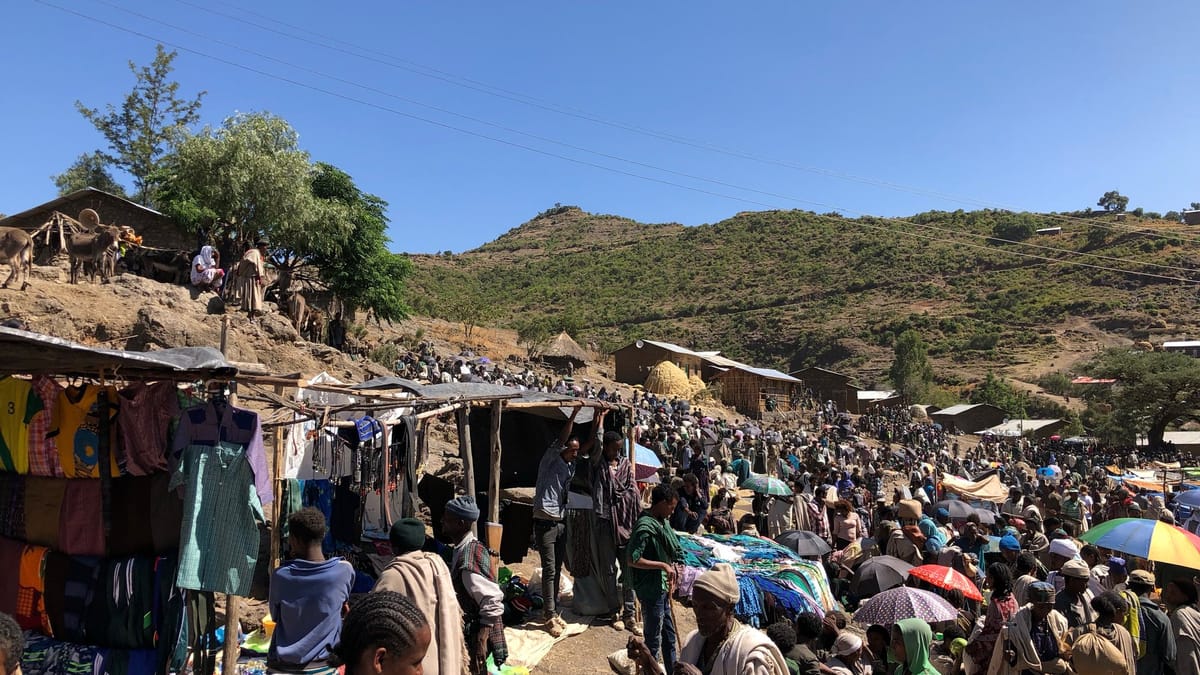
On the way back, we stopped at a market. Maybe three thousand people spread across a rocky hillside with almost no vegetation. The stalls were blankets on the ground, women sitting beside small piles of beans and grain, whatever they had. The meat section was live animals. No refrigeration, no infrastructure. Two lonely trees off to one side. That was it.
Lisa went one direction and I went another. At some point I looked up and saw thousands of faces I didn’t recognize. I couldn’t spot Lisa. I couldn’t spot the driver. For about three minutes I was rattled. Not in danger, just disoriented and briefly afraid in the way that catches you off guard and makes your chest tight.
Three minutes later I’d found everyone and was fine. But here’s what I think about: those three minutes could have defined my entire experience of that place. Fear turns into anger, and anger into the need to get back in control. One very natural way to get back in control is to write a review that puts you on top of the story again, turning “I was scared and lost” into “this place is unsafe,” or “not recommended,” or one star out of five.
I didn’t do that. But I easily could have. And someone else in that same moment, someone with a YouTube channel and a following, might have.
The reverse is just as true and just as distorting. You can be in a place that is unremarkable, with a mediocre hotel and forgettable food, and then someone helps you when you’re lost, or a shopkeeper makes you laugh, or a stranger insists on buying your coffee. Suddenly that unremarkable place becomes “the friendliest country we’ve ever visited.” That’s a review of one interaction you had while standing in the destination, not a review of the destination.
So the positive reviews are mostly wrong too. It all washes out into noise. Except the noise has consequences.
In 2014, a year before Lisa and I left for good, I flew to Cairo for two weeks to meet Ned. He worked for me, and I’d sent him off to work remotely from wherever he liked: an adventure for him, a data point for me. He loved it. I learned a lot. One afternoon we were sitting outside having tea when a little girl, maybe three, it was hard to judge, walked up and laid her head down sideways on our table. Big eyes, looking up at us. She was selling tissues. Her mother stood off at a distance, watching. The girl didn’t say anything. She stayed there with her cheek on the table and waited.
So write the review. Of what? The tea place? The city? The country? The girl? Her mother?
That’s the problem with a review of a destination. It lands on everyone in it, and almost none of them control the thing you’re reviewing. Bunthy doesn’t decide how many tourists come to Angkor. Van and Loan don’t decide what washes up on the beach. The clerks at the Four Points didn’t write Korea’s quarantine rules. The girl didn’t decide to be three years old in Cairo.
I’ll concede the hotel. A review of a hotel has an addressee. The place with the broken air conditioner and the manager who shrugs has a manager, and he can fix it, and the next guest is better off if somebody said so. I know that. I’ve stopped writing those too, because I don’t know what I don’t know, and there is always somebody who gets hurt, whether they deserve it or not.
Because even when I’m disappointed, or angry, or exasperated by the incompetence, the people on the other end of a review are usually doing their best. They’re good people, and they don’t have the advantages I’ve had, most of which I did nothing to earn. I’d rather support them or stay silent. Somebody else can be the mean-spirited asshole. There’s never a shortage of volunteers.
Or maybe it’s simpler than that. Maybe I know I’m too mean to be left alone with a blank review box.
We didn’t buy the tissues. We’d been taught, over and over, that it isn’t a good way to help, so we sat there and waited for her to go back to her mother, and eventually she did. That was defensible. I still think about her. It isn’t a one-off, either. It’s a big part of this life: the people, the babies, the ones who walked out of a war zone, the ones with their head down on your table. It was hard then. It’s hard now.