Four Passports and Nothing to Hide
Two Americans, four identical blue passports, and a Bangkok immigration officer with her hand out. Why the one thing I have never managed to travel lighter on is proof I'm allowed to travel.
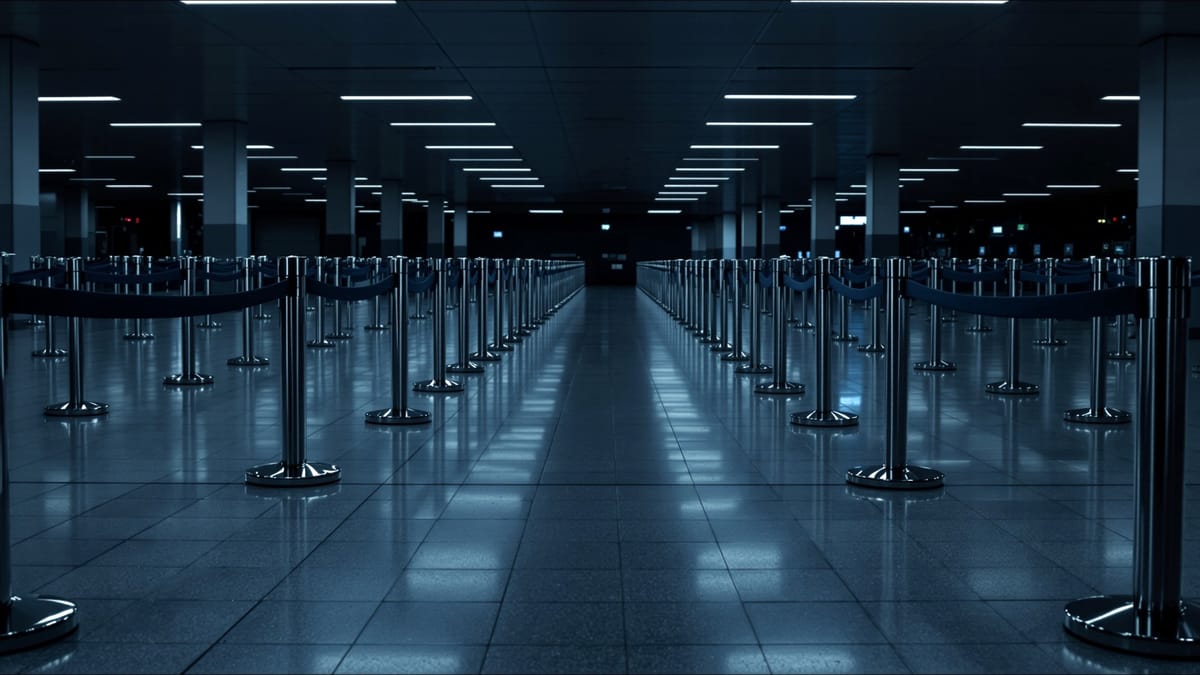
We got lucky with the line in Bangkok, and that was the problem.
You always assume immigration will be long. That is why you rush off the plane and walk fast down the corridor: you want to be near the front, and you want the twenty minutes of shuffling forward, because that is when you do your admin. You get the books out. You work out which one you left the last country on. By the time you reach the counter you are a person with a plan.
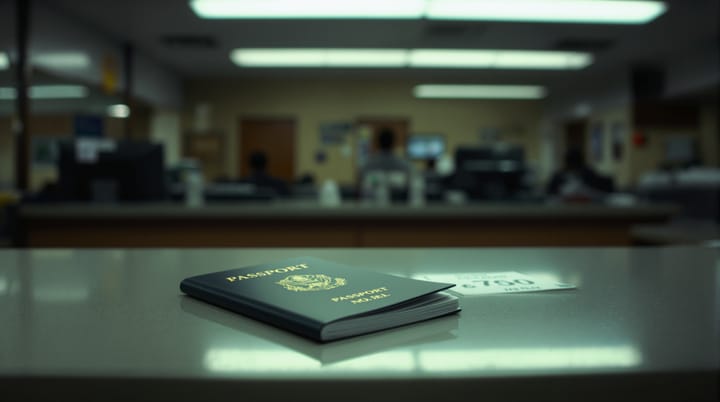
The line was short. We moved through it fast. Then we were both standing in front of the officer with four American passports between us, two each, and no idea which two she was supposed to be looking at.
She held out her hand and waited.
There are signs everywhere in that hall telling you to have your documents ready, and I have walked past them for years. The sweat arrived before the answer did.
Her expression never changed. She was doing her job, which is to watch the person in front of her and decide whether the story adds up, and there we were, a married couple, thumbing through a stack of identical blue books, murmuring to each other about which one we'd used in the last country. I have never felt less like a sophisticated traveler.
They look identical. Same blue, same eagle, same gold lettering, and the only way to tell one of mine from the other is to open it and read the number. We had left the last country on one book each. We were entering this one on the other. That was deliberate. It is also very easy to get backwards when someone is waiting.
Everything I own fits in a carry-on. That has been the project for eleven years, and I'm good at it now: shirts, chargers, shoes, the one jacket, all of it argued down to the smallest set that works. Subtraction is the whole discipline. You get rid of things until what's left is only what earns its space.
There is exactly one category that has never once gone down.
Two of the books at that counter were mine. Lisa had the other two. What she never saw is that I own a third, and before next year I will own a fourth. Every one of them was issued to me by the U.S. government. Every one has my name in it and my face in it. Laid flat on a counter, they do not look like a filing system. They look like evidence.
The ten-year book was running down, so we renewed it through the embassy in London, which went smoothly enough that I have nothing to complain about and therefore nothing to write. They cancelled the old book, punching holes through the cover and the pages, and handed it back. Inside that cancelled book is a Chinese visa with roughly eighteen months left to run. A visa does not die because the passport around it does. So I am carrying a document my own government has voided in order to use a permission that nobody has voided. The book is dead. The sticker inside it is not.
The second passport is a different thing, and most people don't know it exists. The State Department will issue a second book to a U.S. citizen who can justify needing one, valid for four years or less rather than ten, carrying a different passport number and an endorsement code the first book doesn't have.
You sign a statement explaining why you need it. My explanation is the honest one: I don't have an address. When a consulate wants to hold my passport for six weeks, I can't mail it from home and wait, because there is no home and there is no waiting. I'm somewhere, and then I'm somewhere else. The second book is what lets the first one sit in someone's diplomatic pouch while I keep moving.
That second book has a five-year Indian visa in it. Which is why, when it gets replaced, I'll keep it too.
Four books, once that happens. Two valid and in my pocket. Two cancelled, still necessary, and living in the bottom of a bag.
And then there's the page problem, which is the part that produced Bangkok. We fill passports fast. A book with two years left and forty pages of space is a book you should be spending, so you enter and exit on whichever one you're trying to burn down, and you save the pages in the newer book for later. It's the thing an experienced traveler does. It also means that at any given border you may have exited the previous country on one document and be entering the next one on another, and the only record of which is which is in your head, in a line, with people waiting behind you.
Every decision in that stack was the careful one. Renew before you're forced to. Preserve the visa instead of paying for it twice. Carry a spare so a consulate can't strand you. Spend the pages that are about to expire. This is what competence looks like, and what competence produces is two people at a Thai immigration counter fanning documents like a card trick while a woman watches them do it.
What the officer is assessing is whether the person and the paper are the same claim. Multiple books, one face, different numbers, and the holder unable to say without checking which one he last used. Standing there, I could not arrange those facts into any shape that felt innocent. The paperwork that proves I'm entitled to be there is the same paperwork that makes me feel like I'm not.
It gets funnier when the government doing the doubting is the one that issued the documents.
Lisa was stopped at the U.S. preclearance counter in Dublin, where American officers admit you to the United States while you are still standing in Ireland. She was trying to get her second passport added to her Global Entry record. You cannot do that yourself. The government's own instruction is to hand the book to an officer and ask to have it entered, which is exactly what she did.
The officer had never seen a second passport and did not believe there was such a thing. She walked Lisa back through the office, past a room of officers at their desks, toward the cell at the back, which was a real cell and looked like one, while she decided what to do with her.
On the way through, Lisa explained it again to one of the seated officers. He said, oh, that's not a problem at all. Then the others chimed in. Several of them carried second passports themselves, which makes sense once you think about who they are: Americans posted to a border office in a foreign country, needing the same thing from the same government for the same reason.
Lisa never reached the cell. She was released and made her flight. The total damage was some minutes and a raised heart rate, which is the correct amount of damage and still not zero.
I asked her later what had been going through her head on that walk. "In circumstances like that, I rarely have words going through my head," she said. "I remember feeling both shock and outrage, because I knew I hadn't done anything wrong."
The best part is that the U.S. government has an abbreviation for the adjacent version of my problem. When a foreign national arrives with a valid U.S. visa in an expired passport, the officer admits them on the strength of the old book and annotates the new one VIOPP—visa in other passport. There's a code for it. Codes exist because things happen often. None of which helps at a counter in Bangkok, where nobody is consulting an American acronym and nobody wants to hear a retired lawyer explain the distinction between the validity of a document and the validity of a permission.
There's a story people tell about this life where the passport stack is the trophy. Look how many. Look how thick. I understand the impulse and I'm not above it. But the stack records something other than where I've been. It records what has to be true for a person with no fixed address to keep crossing lines that were designed on the assumption that everybody has one. Every book in it solves a problem created by not having a house.
So the bag holds steady and the paper accumulates. I can argue myself out of a second jacket. I cannot argue myself out of a visa I paid for, a cancelled book that still carries a live one, or the spare I need because there's nowhere to send mail. The one thing I've never found a way to travel lighter on is the documentation of my right to travel at all. Next year it gets heavier again.
The officer in Bangkok said nothing at all. That is what they almost always do, and not only in Thailand. They look at you, they look at the screen, they watch you fumble with the fingerprint reader and stand in the wrong place for the photo, and then they look at the screen a while longer. Then the stamp. Then the book comes back across the counter.
Once in a while somebody is genuinely pleased you've come and says welcome to wherever, and it is the best thing that happens all day. Mostly they are waiting for you to gather up your things and move on.
She handed the whole stack back in no particular order, and we stepped out of the line to sort them out. It was over almost as soon as it started, and the only person in that building who thought it looked bad was me.