
Every Ranking Gets Gamed, Including the Gelato
I’ve gamed rankings myself, so I read the gelato lists with a lawyer’s suspicion. The world championship is run by the machine maker, the popular vote follows the tourist trail, and the hospital rankings aren’t much better.
For several years running, my law practice management blog won its category in the ABA Journal’s Blawg 100 reader vote. I’d like to tell you it won because people loved it. It won because we had a mailing list of nearly 30,000 people.
Most of them were former clients, referral sources, and people we’d marketed the firm to. Very few had ever read the blog. Each year we emailed them, explained that winning mattered to us, and asked for their vote. They obliged. We won, and the next year we did it again.
The ABA Journal wasn’t naive. Its editors chose the 100 blogs themselves before opening each category to readers. They threw out votes that came in rapid-fire from a single computer. They said they were looking for affection that was real rather than a marketing hustle. What they couldn’t detect was a real person, on their own computer, casting one legitimate vote for a blog they had never opened. Thirty thousand of those look exactly like a fan base. The Journal eventually dropped the reader vote. I don’t know whether someone figured it out or the budget cuts got there first.
I’ve also bought a thousand copies of a book. The author asked. Bulk orders timed to publication week are a well-worn way to push a book onto a bestseller list, which is why some lists now try to screen them out. I handed the copies out as marketing gifts. If you run a business, you’ve probably gotten some version of that request, or the milder one: pre-order now, so every sale lands on publication day.
So I come to rankings with dirty hands. Every ranking worth winning gets gamed, and the gaming grows with the prize. Nobody has tested that theory more thoroughly than I have, on the most important ranking question there is: where is the best ice cream in the world?
The machine maker’s world cup
Gelato has a world championship. Starting in 2022, the Gelato Festival World Masters ran more than 3,500 gelato makers through hundreds of qualifying events on four continents. In March 2026, 34 finalists from 18 countries met in Las Vegas for the final, held at the International Pizza Expo. Christian Wu of Gelateria Giotto in Brussels won with a tribute to Winnie-the-Pooh: wild honey and pine, with a porcini crumble.
Gelato Festival organizes it. Its partners are Carpigiani, the Bologna company that makes gelato machines; Sigep, the industry’s big trade fair; and the Gelato World Tour, an earlier championship coordinated by Carpigiani’s Gelato University. The Italian semifinals and European finals were held at Carpigiani’s headquarters. The company that sells the machines and teaches the course runs the championship for the trade that buys the machines and takes the course.
The final used a professional jury. The qualifiers can work differently. Time Out’s listing for the Los Angeles stage put the ticket at $27 and tasting the competition flavors at another $25 to $60, with the gelato maker who collected the most votes taking a medal and a place on the road to the world final. It’s the Blawg 100 with a spoon, except the voters pay for the privilege.
The popularity contest
TasteAtlas, a Croatian site founded in 2015, ranks dishes, cuisines, and restaurants on visitor ratings. The company says a proprietary system, which it has described as using AI, strips out bots and patriotic block-voting. Nobody outside the company can check.
In July 2026 it published its ranking of the world’s best gelaterias. The top 20 are all in Italy, and the first shop outside Italy appears at No. 45. Nine of the top ten are in Rome or Florence; Venice takes the tenth. Grom, a chain Unilever bought in 2015 and spun off in December 2025 into the Magnum Ice Cream Company, comes in at No. 9.
A world ranking that follows the Rome-Florence-Venice tourist circuit is measuring where visitors walk. The pattern isn’t new. French television has accused TasteAtlas of rigging a cheese ranking in Italy’s favor, and Malaysia erupted in 2022 over its low cuisine score.
It’s my mailing list, with a passport.
The experts, who disagree
Italy has serious expert guides, and they barely overlap. Gambero Rosso’s latest guide, dated 2027 and published in June 2026, gave its top rating to 77 gelaterias. Dissapore toured the country with a scoring sheet and in June 2026 put Ciacco, in Milan and Parma, first for the second year running. Travel365, which combines its editors with a poll of its readers, some 300,000 of them, ranks VeroLatte in Vigevano first for 2026. The top fives from TasteAtlas, Dissapore, and Travel365 share no names at all.
Then there’s 50 Top Italy, the team behind the influential 50 Top Pizza guide. The most recent edition of its gelato ranking I could find is from 2023. Just over 50 people voted to choose 20 gelaterias, and a smaller panel tasted those anonymously to set the top ten. The honor was called the Pastificio dei Campi Award, after a sponsor that makes pasta. First place went to Gelateria Di Matteo in Torchiara, south of Salerno.
This is also where the closest thing to a signal shows up. All four of 50 Top’s leaders, Di Matteo, Paolo Brunelli in Senigallia, Capolinea in Reggio Emilia, and Soban in Valenza, also appear in Dissapore’s 2026 top 100, compiled three years later by different people with a different method. Italian food critics read each other, so that’s not proof of anything. But when separate panels keep landing on the same shops, you’ve learned more than any single list can teach you.
The lobbying model
At the top of the restaurant world sits the World’s 50 Best Restaurants, owned by the British media company William Reed. More than 1,100 voters cast ballots across regional panels. They must have eaten at the restaurants they nominate within the past 18 months, and they’re asked to confirm it. Nobody asks for a receipt. Deloitte supervises the count.
What the rules don’t forbid is lobbying. Tourist boards have paid for jurors to fly in and eat. A large share of the voters are chefs and restaurateurs, voting on each other. Joël Robuchon, who held more Michelin stars than any chef before or since, called the arrangement an open door to cronyism and geopolitical influence.
The format has since been copied for bars, pizza, and nearly everything else you can eat or drink. The copies inherit the problem.
The guide that gave Robuchon his stars is supposed to be the cure. The Michelin Guide began in 1900 as a free handbook from a tire company that wanted people to drive more, which puts it in the same family as the gelato machine maker’s championship. Its inspectors are anonymous and pay the bill like any other customer, on Michelin’s account. Nobody votes, and there are no jurors to fly in. No one has shown that a star can be bought.
What you can buy is the map. New American cities, and whole countries, now get the guide when a tourism agency pays for it. Tourism groups in five Texas cities put up about $2.7 million over three years; Atlanta’s convention bureau, $1 million; Visit California, $600,000 for the statewide launch. Thailand’s tourism authority paid a reported $4.4 million over five years to bring the guide to Bangkok in 2017.
Virginia’s tourism office was offered a place in the new American South guide for $360,000 and turned it down, citing its duty to taxpayers. Boston went the other way. Its tourism bureau signed a three-year deal reported at just over a million dollars, with Cambridge covering about a quarter of the bill, and in November 2025 the guide arrived and awarded the city exactly one star. That says nothing about Boston’s restaurants and everything about what a million dollars buys.
Michelin says the money doesn’t buy stars. It’s my mailing list again, one level up. The tourism board can’t buy the verdict, so it buys the chance to be judged. Make the judging clean at the restaurant level, and the gaming moves up to the city.
Further up the ladder
None of this is unique to food. The U.S. News college rankings have been gamed for as long as they’ve existed. Columbia dropped from second to eighteenth in 2022 after one of its own math professors, Michael Thaddeus, showed that the numbers it submitted didn’t hold up. Yale and Harvard law schools walked away from the rankings that same year.
Hospital rankings have their own versions of the problem. U.S. News leans in part on reputation surveys that ask doctors to rate hospitals they may never have entered. The data-driven raters have a different weakness: the data. The Leapfrog Group, which grades U.S. hospitals on safety, gave failing grades to five Florida hospitals that had declined to fill out its survey. The hospitals sued, and in March 2026 a federal judge found after trial that Leapfrog had lowered their scores for not participating and ordered the grades taken down. Leapfrog is appealing. In the meantime it has stopped grading any hospital that doesn’t return the survey, which means the safety grade now measures, in part, willingness to be graded. The federal government’s star ratings have rated a small community hospital that does no hip replacements or bypass surgery alongside major medical centers, on the measures it happened to have.
If you can’t trust the hospital rankings, you certainly can’t trust the ice cream rankings. The difference is that bad gelato won’t kill you, so I’ve given it far more of my time.
Where it stops being funny
If you live somewhere, you find a good hospital the way everyone does. You ask your doctor, your neighbor, the friend who’s a nurse. When you travel full time, a medical emergency lands you in a city where you know nobody. If you’re weighing a knee replacement abroad because it costs a fraction of the U.S. price, the rankings are what you reach for.
The more useful signal isn’t a ranking at all. Accreditation is an audit against published standards, which a hospital meets or doesn’t, sometimes after corrective work. Nobody buys a higher position, because there are no positions. The big name internationally is Joint Commission International, which sits inside Joint Commission Resources, the nonprofit affiliate of the U.S. Joint Commission. Temos, a German accreditor, built its standards specifically around hospitals that treat international patients. ISQua, an international body that evaluates the accreditors themselves, has accredited Temos’s standards.
Read accreditation for what it is. The hospital pays for it. The same affiliate that houses JCI also sells advisory services to hospitals; the Joint Commission’s website carries a note that buying them isn’t required to get accredited. The U.S. parent, which accredits most American hospitals, keeps its detailed inspection findings confidential. In February 2026, a Richmond TV station reported that findings at a Virginia hospital where a nurse had broken babies’ bones stayed hidden from the public; the Joint Commission had accredited the hospital in May 2025. That’s the domestic program, not JCI, but it’s the same house. Systematic reviews find that accreditation improves procedures and paperwork. The evidence that it improves survival and readmission rates is thin.
An accredited hospital has cleared a recognized accreditor’s floor, and in a country with weak regulation that’s a meaningful fact. It hasn’t been shown to be good, and it doesn’t tell you whether the surgeon who’ll operate on you is any good. Check the accreditor’s own directory rather than the logo on the hospital’s website. Then ask how many of your procedure the surgeon does in a year.
How I rank ice cream
I’ve eaten ice cream in something like a hundred countries. My method is to go back. Same counter, day after day, for weeks. No judge gets that kind of expense account.
During the pandemic we spent a month in Paris, and I went to Berthillon on the Île Saint-Louis every day it was open. I am still no expert on Berthillon.
About twelve years ago, Lisa and I flew to San Francisco for the single purpose of comparing its ice cream and croissants with what we ate in Paris. The ice cream side of the test rested on three shops: Bi-Rite Creamery, Humphry Slocombe, and Smitten. Humphry Slocombe’s best-known flavor is bourbon with cornflakes, and Smitten freezes each scoop to order with liquid nitrogen. All of it was more inventive, stranger, and more fun than Berthillon. None of it was better. I can’t prove that in any way you could check. My evidence is a month at Berthillon’s counter and nothing more.
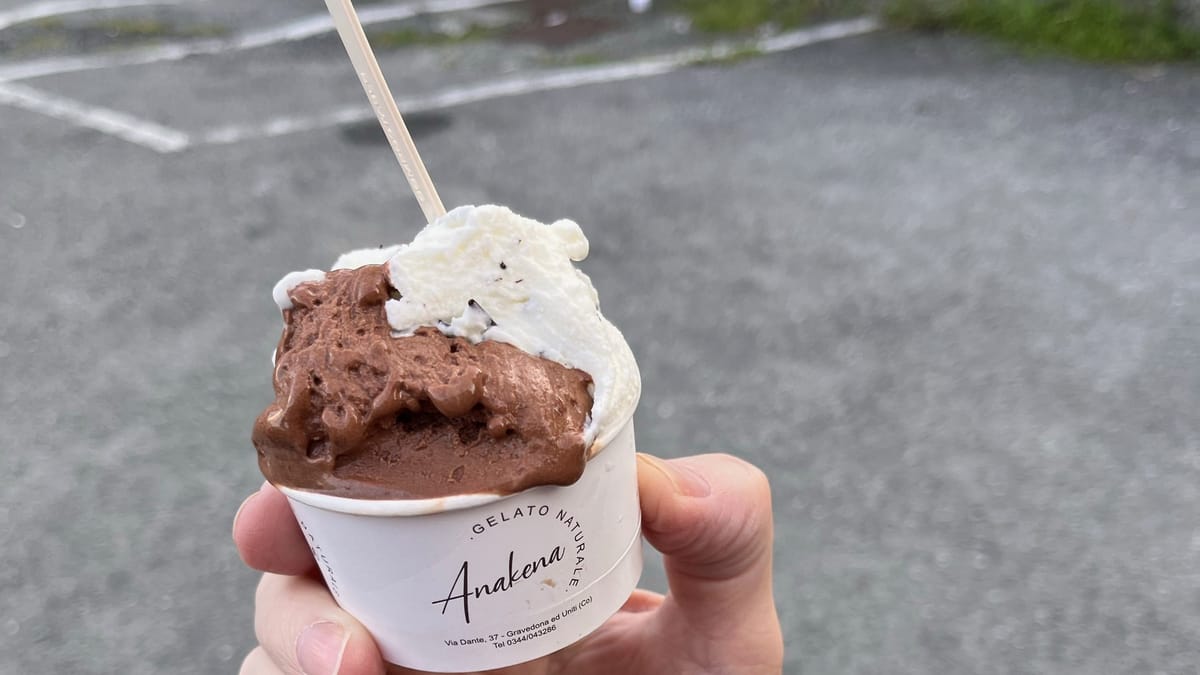
The best gelato I’ve found in Italy is at Gelateria Anakena in Gravedona, a village at the quiet north end of the lake. We rented an Airbnb two blocks away, which made the research easy. Anakena sits a block back from the water and makes its gelato with fresh milk and cream from the Valtellina, the Alpine valley just northeast of the lake.
No world list will find it, and the reason isn’t that it’s obscure. Michelin has covered Italy for decades and has starred restaurants around Lake Como. Its website runs the occasional where-to-find-gelato article, but stars go to restaurants, and a gelato counter isn’t one.
As I write, Tripadvisor ranks Anakena second among Gravedona’s four dessert spots. Gelateria Dell’olmo on the lakefront, the one with the view, draws more reviewers on Tripadvisor and Google alike and scores lower on both: 3.1 on Tripadvisor, 4.0 on Google to Anakena’s 4.7. One Anakena reviewer complained that three euros was too much, since Gravedona is not Bellagio.
The other place I keep going back to is Anya Hindmarch’s Ice Cream Project in London. For about ten weeks each of the last five summers, the handbag designer has turned the Village Hall at her Pont Street shop in Belgravia into an ice cream parlor, with flavors built on brands from British supermarket shelves: Heinz beans, Kikkoman soy sauce, Bisto gravy, Garner’s pickled onions. The lineup changes every year. We went again and again over the past two summers, and my favorite is the Quaker Oats. The flavors are brand partnerships, which in a piece about marketing I should probably disclose. It enters no competitions, and no ranking has a slot for it.
Most of the rankings above are snapshots. Ice cream won’t hold still for one. Last summer’s favorite slips, and you only notice if you go back. The best ice cream I eat this year may not be the best next year.
Law blog rankings matter to lawyers. Bestseller lists matter to authors. Hospital rankings can matter as much as anything in your life. But nothing, and I say this having thought about it for decades, is more important than the ice cream rankings.