Everything I Own: 10KG of Carry-On
Everything Lisa and I own fits in two carry-on bags. Here’s what’s in mine, what it weighs, and why nothing else has made the cut in eleven years.
There’s a storage locker in Cary, North Carolina with some baby photos in it. That’s about it.
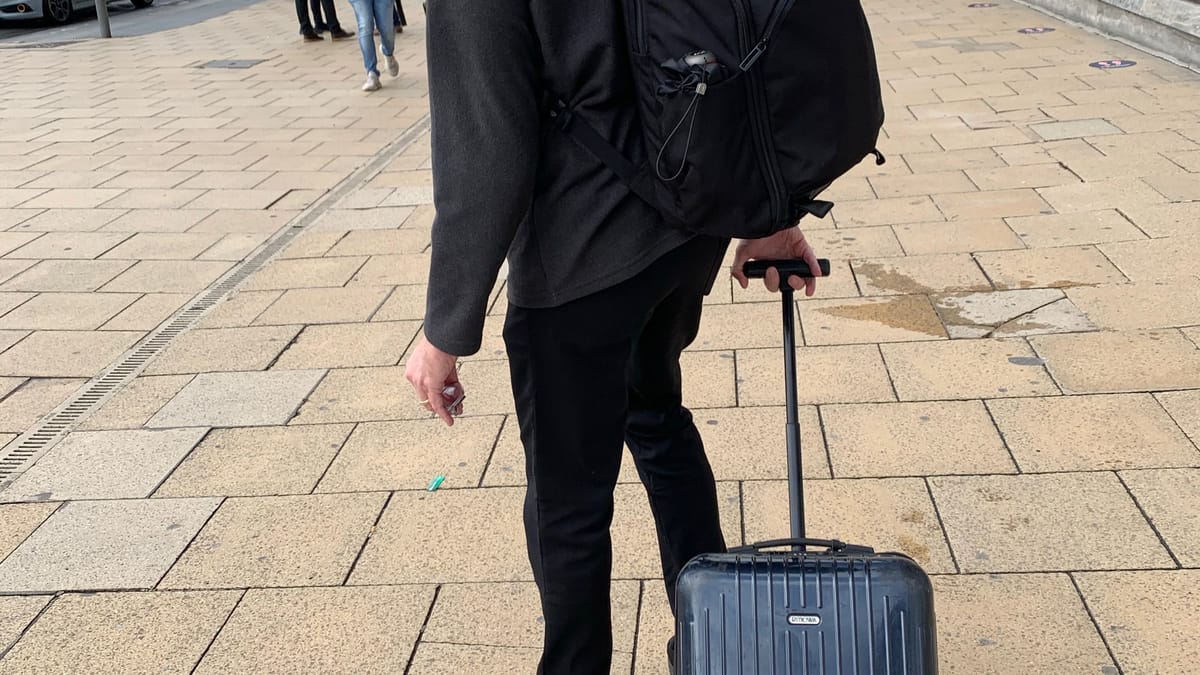
Everything else fits in two bags: a Rimowa Essential Lite roller that goes in the overhead bin, and a Tom Bihn Synik 22 backpack that goes under the seat. Lisa travels the same way. Between us, four bags, none of them ever checked by choice in eleven years.
Packed, my two bags come in around 10 kilograms. That number matters, because 10 kilograms is a common carry-on limit on international airlines, sometimes for the main bag alone and sometimes for everything you bring on board. Discount carriers often allow less.
Almost everything lives in the roller. The backpack is mostly a laptop bag with a few extras.
Lisa figured something out a few years in. If you have a credit card, you have everything you need, right now, within walking distance, in any city we’ve ever been to. The bags are built on that idea.
Eight pairs of Uniqlo Airism boxer briefs. Three pairs of Darn Tough boot-height wool socks in black. Five pairs of Darn Tough no-show socks in white. Those white socks are the only white anything I own. Everything else is black, because nothing mismatches and nothing shows wear.
Two pairs of Outlier shorts, the longer cut. Two pairs of Outlier jeans. Eight Lululemon Evolution Polos, all synthetic, all lightweight. One Montbell Plasma 1000 down jacket from the Japanese maker, lighter and more compressible than anything else I’ve tried. One Marmot Precip Eco rain jacket. One wool beanie. One bucket hat. One pair of HOKA running shoes. One pair of Havaianas.
Prescription glasses. Prescription sunglasses.
A zip-lock liquids bag with toiletries. A Sea to Summit kit with the things you hope you don’t need: Band-Aids, dental floss, and replacement blades for the Panasonic Palm razor, a USB-charging shaver smaller than a deck of cards. SoftSole insoles, because we put serious miles on our shoes and these buy an extra month or two before replacement.
And every January when we leave the US: four prescription medications and four vitamins, totaling more than 2,400 pills. They fill most of one side of the suitcase, and everything else in the bag gets organized around them. (Your medication is a logistical project, and that’s how we treat ours.)
The under-seat backpack holds the MacBook Air, the iPhone, AirPods, and every cord we carry: mostly six inches, a couple at a meter, nothing longer. No backups of anything. One exception: a three-foot Japanese extension cord, unpolarized, more universally useful than anything sold in a US hardware store.
Tom Bihn makes bags by hand in Seattle. They cost about three hundred dollars. That sounds absurd until you stop thinking about your backpack, which happens around week two.
The wallet is a Tumi carbon fiber model, larger than standard because it holds two US passports each (a regular one and a second passport for complicated-visa situations), yellow fever vaccination cards, an International Driving Permit, health insurance cards, transit passes from a rotating cast of cities, a Priority Pass, and more credit cards than is strictly dignified. We are serious about points.
Emergency nuts. Face masks. Zeiss binoculars: compact, real optics, used sparingly but enough to justify the space.
People assume you can only get things at home. They’re wrong, and that turns out to matter.
My glasses prescription hasn’t changed in years. What changes is the anti-reflective coating, which eventually starts peeling and makes the lenses impossible to see through. When that happens, in Lisbon or Bangkok or wherever we are, we walk to an optician and get new glasses. It takes an afternoon.
Early in 2025 we spent about four weeks moving from India to Bhutan to Norway. In midwinter, two of those countries require real cold-weather gear. We had none. Before leaving India we walked into a Decathlon, which has stores across Asia and sells functional base layers for nine dollars, bought what we needed, wore it through Bhutan and twelve days on a Norwegian ferry, and donated everything in Bergen before we got off the boat.
We have also had our bags lost for twenty-three days. Austrian Airlines. They knew roughly where the bags were the entire time and simply couldn’t deliver them. You learn fast how little you actually need.
None of this is zero-impact. We fly constantly, so the carbon math is complicated no matter what’s in the overhead bin. Buying cheap gear in India and donating it in Norway isn’t a clean transaction. Neither is anything else about how we live.
The Rimowa is expensive and thin-walled and occasionally alarming when airlines handle it roughly. The Montbell compresses to the size of a softball. The Outlier pants have survived more countries than most people visit in a lifetime. None of it matters as much as the credit card in the wallet.
The locker in Cary holds the baby photos. Everything else either fits in the overhead bin or it doesn’t come.