The Fire Next Door
Protesters burned the pension office next to our hotel in Patagonia, with our rental car parked in between. The card covering that car had an exclusion written so it could refuse to pay a peso.
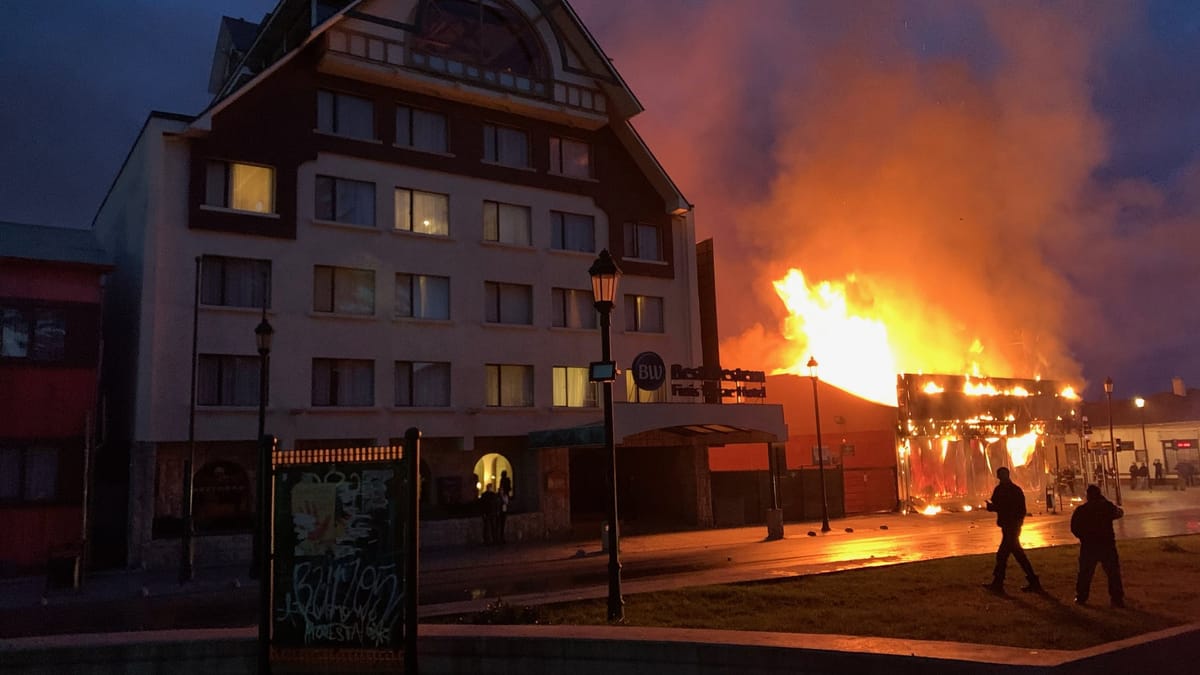
On the night of November 12, 2019, protesters in Punta Arenas, Chile, burned down a pension office. Our rental car was parked in a gated lot between that office and our hotel. If the car had burned with it, the credit card I was counting on to cover it had an exclusion written so it could refuse to pay a peso.
Nothing happened to the car. I didn’t read the exclusion until later, and when I did I was glad the car hadn’t burned and disappointed in the coverage.
The night of the fire
Chile had been in the streets for weeks. The estallido social started in Santiago in October, and we had gone out to watch the marches there: families, signs, banners, nothing that felt dangerous. Each night got a little more intense, with water cannons blasting protesters and protesters aiming laser beams at police drones to bring them down. We left and flew to Punta Arenas, about as far south as Chile goes. The protests came with us.
We were staying at the Best Western Finis Terrae on Avenida Colón. For a few nights the marches outside were unremarkable. On the 12th, the day of a national general strike, they changed. People were burning tires in the street, and a line of fires ran along the block in front of the hotel. Most of the guests were at the windows. It was entertaining. Nothing had happened on the earlier nights, and nobody expected anything to happen on this one.
Then we noticed the building next door was on fire. It was a small two-story branch of AFP Habitat, one of the private firms that run Chile’s pension system, and the pension system was one of the things the country was protesting. Flames rose a full story above the roof. Our rental car sat in the narrow gated space between the two buildings.
Earlier that day I had put a long, unmissable scratch down the side of that car, with a dent to go with it. I’d been bracing for the damage claim at drop-off, and I told my wife, Lisa, that if the car burned, at least we wouldn’t have to pay for the dent. It took me a while to understand that a burned car would cost us far more than a dent.
The hotel evacuated us into the street, which by then belonged to police who looked like soldiers: black uniforms, body armor, shields and rifles. There were water cannons, tear gas and, I’m fairly sure, rubber bullets. In the rush I grabbed a backpack. It held our dirty laundry; our passports were still upstairs.
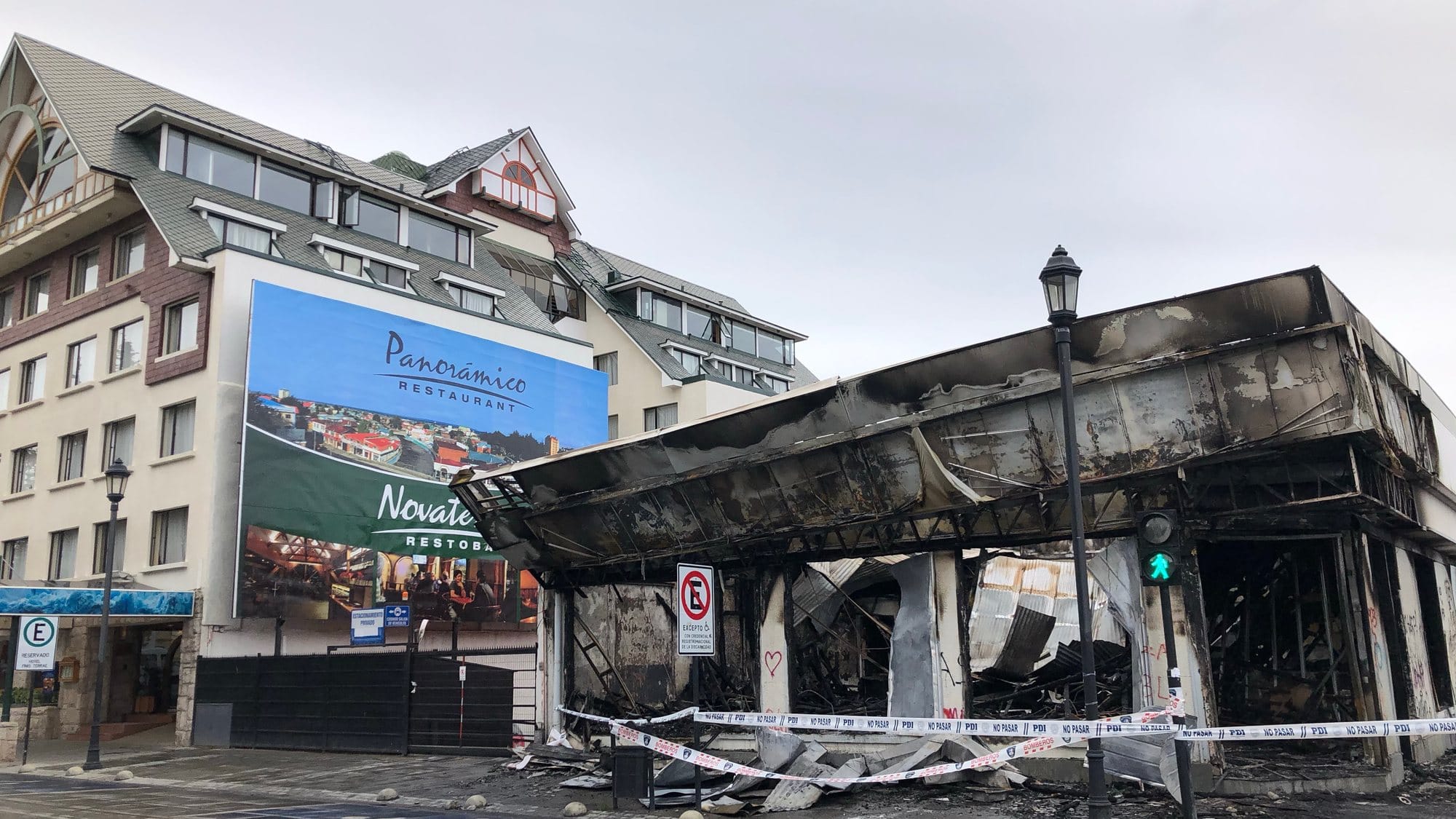
Some guests came down with their bags packed, flagged taxis, and headed for the airport. I thought they were overreacting. They were the only ones acting on what any of us knew at that moment, and I was the one holding a bag of laundry. Within an hour the fire department had the fire out, the street was quiet, and we went back to bed. The next morning we walked over and looked at what was left of the office.
What the card says
I rented that car on a Chase Sapphire Reserve, which offers up to $75,000 of primary rental car coverage when you decline the rental company’s collision damage waiver. I declined it in Punta Arenas, so the card was the only thing standing between me and the bill for that car. It is a good benefit, with more gaps than the marketing suggests. It also has an exclusions list, and this is on it:
Theft or damage due to hostility of any kind (including, but not limited to, war, invasion, rebellion, insurrection, or terrorist activities)
That is the wording in the current guide. The words “riot” and “civil commotion” don’t appear anywhere in the exclusion, and as a lawyer I’d tell you that leaves an argument. The drafter didn’t need those words. “Hostility of any kind” followed by “including, but not limited to” is written to catch whatever the list doesn’t name, and a claims adjuster looking at a car burned by a crowd that had just set fire to a pension office will read it that way.
You might win the argument. Courts have read war and insurrection exclusions narrowly before. In 1974 the Second Circuit, the federal appeals court in New York, held that the hijacking and destruction of a Pan Am 747 was not “war” or “insurrection” for insurance purposes, and in 1983 a federal trial court in New York held that damage to the Holiday Inn in Beirut during the Lebanese fighting was riot and civil commotion rather than war. Both were large commercial losses litigated for years. You would be making the same argument over a rental car, from a hotel room in Patagonia, while the rental company bills you for the car.
The comprehensive coverage on a standard US auto policy usually pays for riot and vandalism damage. It doesn’t travel. The standard policy territory is the United States, its territories and Canada, so a rental car in Chile is outside it before the question of riots ever comes up.
Paris, twice
The car exclusion is about property. The bigger gap for most travelers is time.
Paris gave us two near-misses this year. The first was the night in May when Paris Saint-Germain won the Champions League: about 780 people were detained across France, and all it cost us was the sight of smashed glass at the bus stops near our hotel.
Last month was closer. We checked out of the Crowne Plaza at Place de la République on Friday, October 16. On Saturday the square was the starting point for a cost-of-living march backed by students, teachers and several unions. Reporting put the Paris crowd at about 110,000, police made 855 arrests, a record for the city, and the prefecture closed roughly 25 metro stations for the day. Had we stayed one more night, we would have been inside the march.
Suppose that had cost us two days. The Sapphire Reserve has trip interruption coverage, and it reimburses lost prepaid travel for a defined list of reasons: illness or injury, severe weather, jury duty, quarantine, a home or lodging made uninhabitable, an organized strike affecting public transport that costs you at least 20 percent of the trip, and a terrorist incident within 25 miles of your airport or booked lodging.
Civil unrest and riot appear nowhere on that list. The exclusions mention civil unrest exactly once, to refuse “disinclination to travel due to civil unrest.” A cost-of-living march that ends in looting doesn’t qualify as a terrorist incident either, and nobody is going to designate it as one so your claim can go through. The weather clause shows the gap most clearly: it covers you if a storm forces you to stay put at your booked lodging. The policy contemplates being trapped in your hotel by a hurricane, but not by tear gas. If a riot actually wrecks your hotel, the uninhabitable-lodging clause might pay. If it only keeps you inside, nothing does. Terrorism, meanwhile, is a reason to pay you on the trip side and a reason not to pay on the car side. Civil unrest isn’t named as a reason to pay on either side.
The strike clause looks like an opening, since unions backed the October 17 march. It closes quickly. The metro stations shut because the police prefecture ordered them shut. No transit workers walked out.
If you travel full-time the way we do, one more line looks like it rules you out altogether: no coverage for a trip scheduled to last longer than sixty days. It doesn’t, because the guide defines a trip by the booking and says nothing about going home, so a week in Paris booked as its own week can stand as its own trip. The rental car coverage is simpler still. Its limit is 31 days per rental, so a full-time traveler qualifies on the same terms as someone on a ten-day vacation. That is the coverage that would have mattered in Punta Arenas, and the hostility exclusion is where the fight over it would have happened.
More insurance is not a simple fix
Standalone travel policies vary widely. Some exclude riot and civil disorder outright; others reach it indirectly, through a security evacuation benefit or a clause for lodging made uninhabitable. Most of them have a foreseeable-event rule: once protests are in the news, a policy bought afterward generally won’t cover losses that flow from them. Chile in November 2019 had been a known event for more than three weeks.
The products that sidestep the cause are Cancel For Any Reason and its less common sibling, Interruption For Any Reason. CFAR typically refunds 50 to 75 percent of your nonrefundable prepaid costs, has to be bought within a couple of weeks of your first trip deposit, and usually requires you to cancel at least 48 hours before departure. Both are expensive, and both are sold on trips with a start and an end date.
Before you pick up the car
If a country you’re headed to is in the streets, find the hostility and war exclusions in your card’s benefit guide before you sign the rental agreement. Then decide whether the rental company’s own waiver is worth buying for that trip, knowing that choosing to buy it switches the card’s coverage off. Ask the counter what its waiver excludes; the answer varies by company and by country. Or skip the rental entirely: if you’re going to go watch the marches the way we did, take an Uber. When that car burns, someone else gets to read the exclusions. And keep the passports in whatever bag you would grab first.
The fire could have jumped the gap; it didn’t. The car went back to the rental counter with the scratch and the dent I had put there that afternoon, and the rental company never asked me to pay for either. That happens sometimes. It roughly balances the times a rental company bills you for damage that isn’t there.