Your Credit Card Doesn’t Cover What You Think It Covers
Your credit card covers the rental car. It doesn’t cover the person you hit, and once you leave the US, your American auto insurance probably doesn’t either.
A woman at a rental car office in Santiago, Chile was trying to explain the insurance coverage to us. She spoke only Spanish. We spoke only English.
She grabbed a fat marker and drew a car on a piece of paper. Then she drew the car tumbling off a cliff, flipping end over end.
“Boom,” she said.
That was the extent of our insurance briefing. We signed the contract, in Spanish, and drove away.
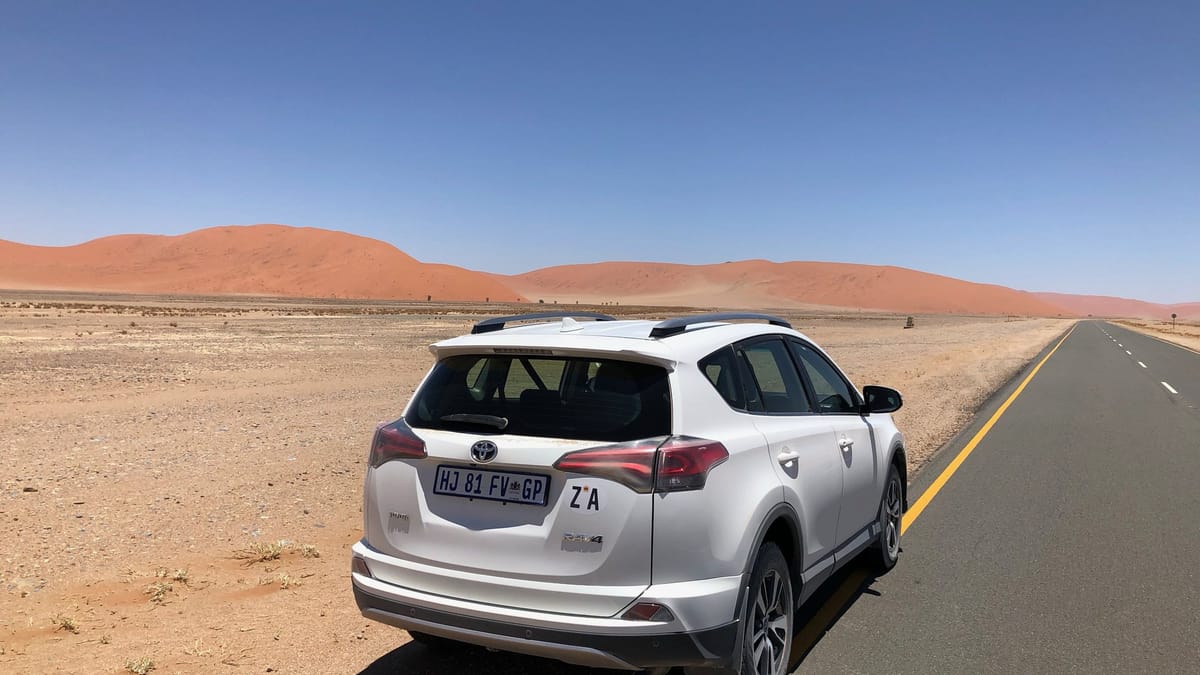
Lisa and I have been full-time nomads for years. We’ve rented cars in Japan, Albania, Georgia, Morocco, South Africa, Cyprus, Namibia, Taiwan, Argentina, Chile, and a bunch of other countries. We’ve driven across borders, navigated chaotic traffic, and signed rental contracts we couldn’t read.
And until recently, I hadn’t fully thought through what would actually happen if we hit someone.
I’m a lawyer. I carry a non-owner auto insurance policy. I have a large umbrella policy. I use premium travel credit cards. And I still had a gap in my understanding that I should have caught years ago.
(A note before we start: this is written for American travelers. The products, policy structures, and gaps described here are American, though much of the analysis applies more broadly.)
What your credit card actually covers
Several premium travel cards, including the Chase Sapphire Reserve and the Capital One Venture X, include primary auto rental collision damage coverage. It works like the rental company’s Collision Damage Waiver (CDW), but it’s built into your card’s annual fee. Pay for the rental with the card, decline the rental company’s CDW, and if the car gets scratched, dented, or stolen, the card’s insurer picks up the bill without involving your personal auto policy. (The Amex Platinum’s built-in rental coverage is secondary; Amex sells a separate Premium Car Rental Protection add-on that’s primary.)
That’s useful. It can save you $15 to $30 a day.
What it doesn’t cover is liability, at all. If you rear-end a minivan full of kids, your card covers the rental car you’re driving. It doesn’t cover the minivan, the medical bills, or the lawsuit.
That isn’t a quirk of one card. The standard rental benefits on Visa, Mastercard, and Amex cards cover damage to the rental car, and none of them cover what you do to other people.
The fine print worth knowing
Country exclusions move. Historically, many Visa and Mastercard policies excluded Ireland, Israel, and Jamaica, and Amex often excluded Italy, Australia, and New Zealand. Top-tier cards have dropped many of these exclusions, but mid-tier cards often keep them. Check the “Territory” or “Exclusions” section of your card’s Guide to Benefits before every trip.
Italy is its own thing. Italian rentals generally include basic collision and theft coverage that you can’t decline. Since many card policies require you to decline the rental company’s coverage, that creates a Catch-22. Some premium cards, including the Chase Sapphire Reserve, have confirmed they’ll still cover you in Italy. Others are less clear. Call your issuer.
The contract length is what counts. Card CDW benefits cap the rental length, commonly at 31 days, and some cards use shorter limits at home than abroad. It isn’t only about returning the car in time: the rental contract itself needs to be within the limit. Sign a 45-day contract and the coverage may never apply, even if you bring the car back on day 30. If you need a car for six weeks, don’t sign one 42-day contract. Break it into two 21-day contracts with a return and re-rent in the middle, but read your card’s terms first: some treat back-to-back contracts as one rental.
Vehicle restrictions. Most cards exclude “expensive, exotic, and antique” vehicles, and many exclude trucks, which can include some SUVs, and open-bed vehicles. If you’re renting a Land Cruiser for a Namibian safari or a luxury van for a group trip, your card may treat it as a total exclusion.
Decline the rental company’s CDW in full. To trigger your card’s benefit, you almost always have to decline the rental company’s collision coverage entirely. Get talked into “partial” or “supplemental” coverage by a pushy agent and you may void your card’s coverage altogether.
The hold on your card. Declining the rental company’s CDW has a hidden cost: the security deposit. When you buy their coverage, they might hold a few hundred dollars on your card. When you decline it, you’re telling them they’ll have to come after you if you wreck the car, and many companies respond with a much larger authorization hold, anywhere from $600 to $15,000. It isn’t a charge, but it eats your available credit for the rental and several days after. On a tight credit limit, that one hold can leave you unable to pay for your next flight.
The most dangerous place to drive is home
Before we go international, let’s talk about the United States.
If you’ve given up your car, as many nomads have, you probably don’t carry a personal auto policy. When you rent a car in the US, your card covers the rental vehicle. Your liability to everyone else is a different story. In some states, the rental company’s own coverage stands behind you at the state minimum, and those minimums are low. Many states set them at $25,000 per person and $50,000 per accident for bodily injury. Florida requires $10,000 in property damage liability and no bodily injury liability at all.
And the US is the one country where damage awards are enormous. Punitive damages get the headlines, but it’s the compensatory awards for medical bills, lost wages, pain and suffering, and wrongful death that routinely run into the hundreds of thousands or millions of dollars. State-minimum coverage, if you have it at all, won’t come close.
So the most dangerous place to drive underinsured isn’t some developing country with chaotic roads. It’s the United States, and plenty of nomads do exactly that every time they rent a car at the airport.
That’s why Lisa and I carry a non-owner auto policy through USAA. It covers our liability when we drive any car we don’t own (rentals, borrowed cars, car shares) within the US and Canada. The limits are $300,000 per person, $500,000 per accident, and $100,000 for property damage, which satisfies the underlying requirement of our umbrella policy, which adds $3 million on top.
In the US, that’s solid protection. The problem is everywhere else.
Your American insurance doesn’t travel
Our USAA non-owner policy is explicit: its territory is the United States and Canada. That’s standard across the industry. Whether you have an owner’s policy with State Farm or a non-owner policy with Progressive or USAA, your American auto insurance generally stops at the border, with some policies covering short trips just across into Mexico.
I knew this. It’s right there in the policy.
What I hadn’t thought through was the consequence. When we rent a car in Japan or Chile or South Africa, nothing from the American insurance system stands behind us on liability.
That leaves the umbrella.
The umbrella question
There’s an important distinction between a true umbrella policy and an excess liability policy. They sound alike and work differently.
An excess liability policy “follows form.” It only extends coverage that already exists in your underlying policies. Your US auto policy doesn’t apply abroad, so an excess policy has nothing to sit on top of. No underlying coverage means no excess coverage.
A true umbrella is broader. According to the International Risk Management Institute (IRMI), the territory of most personal umbrellas is worldwide, while the personal auto policy covers only the US and Canada. A true umbrella can “drop down” and provide primary coverage for auto liability abroad, subject to a self-insured retention, which works like a deductible and is often $10,000.
Our USAA policy is titled “Personal Umbrella Policy,” which suggests it’s a true umbrella. But I’m looking at our declarations page right now, and it doesn’t contain the policy language that would confirm worldwide auto liability coverage. The endorsements that would spell it out are referenced but not included in the renewal packet.
I should have read the full policy form years ago. I haven’t. That’s on me.
What I can tell from the declarations: the umbrella requires underlying auto coverage of $300,000/$500,000. In the US, our non-owner policy meets that and the umbrella sits above it. Abroad, if the umbrella drops down, there’s likely a self-insured retention, so we’d pay some initial amount ourselves, possibly $10,000 or more, before the umbrella starts paying.
What you should do: read the actual policy form, not the declarations page or the renewal letter. If you don’t have it, ask your insurer to send it. Find the territory clause and the exclusions, and work out whether you have a true umbrella with worldwide drop-down coverage or an excess policy that only follows your underlying coverage. And don’t trust the label. A policy called an umbrella can still exclude foreign auto claims; only the policy language tells you. Worse, some umbrellas pay as if the required underlying coverage existed, which abroad could leave you paying the first $300,000 yourself. That one reading could mean the difference between $3 million of protection and very little.
So what covers you abroad?
When you rent a car outside the US, your liability coverage is usually whatever the rental company provides, as local law requires. And some countries barely require any. South Africa, where we’ve driven, doesn’t require third-party motor insurance at all; injury claims go to a state fund.
That’s basically it.
I looked hard for a standalone product that gives American consumers worldwide third-party liability coverage for rental cars. It doesn’t appear to exist. Travel insurance add-ons from companies like Allianz and Seven Corners cover damage to the rental car. Third-party CDW providers like RentalCover cover damage to the rental car. None of them cover your liability to the person you hit.
So the question becomes what local law requires. The answer falls into three tiers.
Tier one: the EU and the UK
If you’re going to have a car accident abroad, Europe is the place to do it.
I’m only half joking. The EU has the most comprehensive mandatory auto liability system in the world. Under the Motor Insurance Directive (2009/103/EC), every vehicle on the road must carry third-party liability insurance, and for rental cars it’s included in the price. The harmonized EU floor is €6.45 million per accident for personal injury and €1.3 million for property damage, and individual countries go higher. Spain’s compulsory limit for personal injury is €70 million. The coverage is tied to the vehicle, not the driver, so it follows the car across the EU and EEA.
The UK is, if anything, better. Under the Road Traffic Act 1988, every car must carry unlimited third-party liability for bodily injury, plus £1.2 million for property damage, included in every rental at no extra charge.
Between that mandatory liability and your card’s CDW for the car itself, you’re well covered for most scenarios in Europe.
For long stays, there’s another option. Beyond the well-known manufacturer lease-buyback programs from Peugeot and Citroën, companies throughout Europe rent cars by the month with comprehensive insurance, including liability, built in. For a month or more, they can be cheaper than daily rentals, and they can sidestep the credit card duration problem, as long as the included coverage is solid.
Tier two: Green Card countries
Most people have never heard of the Green Card system, but it’s the backbone of cross-border auto liability across a big swath of the world: more than 40 countries, covering Europe and parts of North Africa and the Middle East. Albania, Morocco, Turkey, and Tunisia are all members. When you rent a car in one of them, the rental company must carry third-party liability insurance, and the Green Card provides cross-border recognition.
But “required” and “robust” aren’t the same thing. Limits vary, enforcement varies, and crossing borders gets complicated.
We rented a car in Albania and planned to drive into North Macedonia. The rental company told us we’d need a Green Card, a separate document proving our liability coverage was valid across the border, and sent us to an office down the block. We went the day we picked up the car. They couldn’t produce the paperwork that day, and we had to come back the next morning.
It was a good thing we were staying in town. If we’d planned to pick up the car and head straight for the border, we’d have been stuck. Green Cards can now be issued electronically, which should help, but ask about cross-border paperwork when you book, not at the counter.
Tier three: everywhere else
Japan, Taiwan, Australia, most of Asia, Latin America, sub-Saharan Africa.
In many of these countries, compulsory auto liability insurance exists and comes with your rental. But the limits can be far lower than in the EU. In Taiwan, compulsory coverage pays about NT$2 million, roughly $62,000, for a death or the most severe disability, and far less for ordinary injuries. In Japan, compulsory insurance (jibaiseki hoken) covers basic bodily injury, and most Japanese drivers buy voluntary insurance on top because the compulsory limits are modest.
And then there are the places where you don’t really know what you have.
In Chile, a woman mimed our coverage with a marker and a sound effect. In Japan, we signed contracts in Japanese and hoped for the best. In South Africa and Namibia, we drove remote roads without any real understanding of our liability exposure if something went wrong.
That’s the thread running through all of it: you’re signing contracts you can’t read, in languages you don’t speak, and relying on gestures and Google Translate to understand your coverage. Calling ahead doesn’t help much, because phone representatives rarely know the details and nothing they say is binding. The contract you sign at the counter governs.
The real exposure abroad
Here’s where my legal background matters, because the risk outside the US is different, though not necessarily smaller.
American damage awards are far larger than almost anywhere else. Most of the world uses civil law systems where damages are meant to make the victim whole, not to punish. Pain-and-suffering awards in Germany are modest by American standards. Spain values injuries using statutory tables. Courts in Poland and Austria award a fraction of comparable US verdicts. Multimillion-dollar awards are rare in Albania or Taiwan in a way they aren’t in Texas.
The danger abroad is what happens to you.
Criminal liability. In many countries, causing a serious accident can bring criminal charges, not just a lawsuit. In Mexico, drivers in injury accidents can be held while authorities sort out who pays. In Japan, negligent driving that causes injury is a crime.
A US Navy lieutenant stationed in Japan caused a fatal accident in 2021. He was convicted of negligent driving and sentenced to three years in prison, and spent 537 days locked up.
The host of The Daily Churn, a credit card churning podcast, was arrested in Tokyo in January 2020 after a car accident and spent four days in a Japanese jail. He covers the arrest, the interrogation, and the lawyer who got him out in a four-part series (episodes 65, 67, 71, and 73). Four days was a relatively good outcome.
Practical detention. Even without charges, the police may hold your passport, the rental company may freeze your card, and you may not be able to leave the country until the matter is resolved. The money might be modest by US standards. The disruption to your life won’t be.
Local law governs. The law of the country where the accident happens decides liability, in that country’s courts, on its timeline, in a language you probably don’t speak.
Insurance helps, partially. It solves the money problem: if the rental company’s liability coverage or your umbrella pays the claim, the injured person is compensated. It can also speed things up, because in many countries, Japan included, settling with the injured party can influence whether criminal charges go forward and how they end.
But insurance won’t prevent your arrest, get your passport back from the police, or walk you through a foreign criminal process.
What to do
There’s no elegant global solution. Your US auto insurance doesn’t follow you overseas. Your credit card and travel insurance cover the rental car but not liability. Your umbrella might drop down abroad if it’s a true umbrella, but you have to read the policy to know, and even then there may be a significant retention. Abroad, the only liability coverage you can count on is whatever the local system provides through the rental company.
In the US, fix this first. If you’re a nomad without a car and you rent in the US, get a non-owner auto policy. It’s the easiest gap to close, and it’s where the big judgments happen.
In the EU and UK, use your card for the car. Mandatory liability does the heavy lifting. Check Italy with your issuer, and look at monthly rentals for long stays.
In Green Card countries, sort the paperwork early. The coverage is real, but cross-border documents can take longer than you expect.
Everywhere else, think hard. If you can’t find out what liability coverage comes with the car, because it isn’t available in a language you read or the limits look thin, renting there may be a risk you shouldn’t take. Where the stakes are high and the information is opaque, it may be worth asking an international insurance broker, an expat forum, or a local English-speaking lawyer before you sign anything.
Read your umbrella policy. I’m saying that to myself as much as to you.
Watch the clock on long rentals. Card CDW has a length limit, commonly 31 days, and it may be measured by the contract, not by when you return the car. For longer trips, use the rental company’s CDW or a monthly rental that includes coverage.
You’d check an airline’s safety record before flying it in a developing country. Most of us, myself included, hand over a credit card at a rental counter without knowing what happens if we hurt someone. In the EU and UK, the answer is reassuring. In a lot of other places, it’s a woman with a marker drawing a car going off a cliff. Sometimes the right answer is to rent the car. Sometimes it’s to take a taxi.
I’m not your lawyer, and this isn’t legal advice. It’s one nomad working through a problem most of us ignore.