2026 - 11 Years as a Digital Nomad Lawyer
Eleven years in. We sold the company, got on a plane, and spent a year finding out what's left when you keep subtracting: tigers in the rain, jets over Okinawa, a funeral and a kid waiting at a Bangkok gate thirty-eight hours later.
We live in the in-between.
Not quite here, not quite there.
We're in the back seat of an Uber, gliding through traffic in a city we've never seen in daylight. We're at the gate at some airport, waiting for a boarding group to be called in a language we don't speak. We're in the hallway of a hotel, trying to remember which room is ours this week.
This is liminal space. The space between destinations. The float between what was and what's next.
Where We Happen
And it's where this life happens.
It's where the surprises show up, the awkward, beautiful, and bizarre ones. Sometimes it's the hotel lobby in Medina that turns us away because of our religion. Sometimes it's the Airbnb in Austria where we all down a shot of schnapps and shout "Gesundheit!" like we've been friends for years.
But it's not just where the travel happens.
It's where we happen.
Liminal space has a way of holding up a mirror. You're sitting in the back seat, staring out the window, and suddenly you're not thinking about the next check-in or the currency exchange rate. You're thinking about you. All of you. The raw parts. The stuff you usually keep buried under appointments and errands and plans.
Out here, it's laid bare.
What We Subtracted
When we started this life eleven years ago, we thought we were leaving behind stuff. And we were. Almost everything we owned got reduced to what would fit in a carry-on bag. What we didn't realize was that we were also leaving behind the people. The community of service and familiarity.
The handyman. The shrimp guy on the corner. The barista who knew our order. The dentist who remembered our name. The trainer who checked in when we missed a workout. The restaurant owner at our regular place who asked about our vacation plans.
We didn't just lose weight in luggage. We lost the acknowledgement, the support, the comfort of being known.
Partway through this year I subtracted one more thing. At midnight on New Year's Eve, I sold the company I'd built and run for more than a decade. I'll come back to what that did to me later, because it took months to feel it. For now, just put it on the pile: the house, the people, and now the job title too.
What We Got Back
What we got in return was space.
Sometimes it feels light, free, expansive. Sometimes it feels like a big, echoing emptiness.
Lisa likes to say, "It's not for everyone." And it's not. There's no formula here. No clean answers. Some people crave structure. We've come to crave the room where structure used to be.
That space can be painful. It can be uncomfortable. But it can also be filled: with new ideas, new experiences, new connections you don't see coming. It's a passage, not a void, and a passage isn't better or worse than what came before. Just different.
And once you step into that different space, you live there. With the uncertainty. The possibility. The strange, quiet reckoning that comes with a one-way ticket and a world that no longer feels built around you.
What follows is the record of a year of that. Destinations, yes. But really, a year of finding out what's left when you keep taking things away.
Trieste, Italy
Trieste amplifies this feeling. We arrived with my brother, his wife, and my mother in tow. Family travel, joyful chaos. Routines collide. Rhythms clash.
Lisa and I have perfected our quiet choreography. Add others, and suddenly we're bumping elbows at tiny bar tables. Debating meal plans. Negotiating departure times.
Logistics aren't the challenge. It's blending rhythms. We're accustomed to solitude. Or the easy synchronicity of two. Family adds layers: patience and compromise we're rusty at providing.
But Italy softens that friction. Familiar food. Known culture. Relatable surroundings. We're strangers, but it's our kind of strange. Like dining at Olive Garden: comfortably predictable. English might be limited, but everyone speaks pizza and pasta.
Trieste itself is modest. Fewer than a quarter-million residents. It is a cruise ship stopover, where tourists bus out to Venice for the day. It is quiet enough for us. Relaxed, but lacking the buzz of bigger destinations.
Why Trieste? Literary history: James Joyce walked here. Convenient geography, just an hour from Ljubljana, where our family joined us. Would I pick Trieste again for five family days? Probably not.
But Trieste isn't really the point. The people are.
My mother is in her late eighties. My brother and his wife have their own lives, their own schedules, their own orbits back home. The window where all of us end up in the same city at the same time is narrow, and narrowing. A visit like this isn't a vacation. It's a deposit against a running balance that I can't replenish.
That math sits underneath the whole week. When my mother wants to stop and rest, we stop and rest. When my brother's rhythm is different than ours, we bend ours to his. The friction I described earlier (the bumping elbows, the negotiated meals) stops feeling like friction the moment you do the arithmetic. Five days with my mother at eighty-seven is not a trip. It's five days.
You don't get many of those left. You don't know which one is the last one.
The roles shift without anyone announcing it. The kid at the family table becomes the one managing the family table, and nobody stops to acknowledge the trade.
So you pick a modest city, you compromise on the rhythm, and you show up.
That's what we learned. Everyone already knows family travel is hard. What we learned is that the hard part is the point.
The United Kingdom
People who've heard about this life like to say you must need things to keep getting more exotic. Eleven years in, you'd be chasing the next further-flung place, the next harder-to-pronounce city, the next visa nobody at home has ever applied for.
That's not how it works.
We left Trieste, took a flight, and landed back in the UK (England, then Scotland) and the British Isles are not exotic. Not by a long shot. They are familiar. They are comfortable. The signs are in English. The food is recognizable. You walk into a pub and you know what's happening. We love them anyway.
The UK is beautiful in a way that doesn't need translating. Wet, windy, chilly. Old stone buildings engineered for winter, which is a problem when a heatwave hits and your Airbnb's AC gives up. We took our money, walked across town, and checked into a Hyatt with air-conditioning that actually worked. Expensive. Worth it.
What I didn't expect in London was the theatre.
I've never been the one pushing for shows. That's been Lisa's thing, historically, and I've gone along for the ride. This time I went in headfirst. We saw several productions over two weeks and I had an actual blast: Broadway-quality work at a fraction of what the same night would cost in New York. Familiar plays in unfamiliar accents. New ones I wouldn't have picked on my own. The whole range.
I don't know exactly what changed. I'm the same guy who used to find theatre mildly dutiful. But something clicked, and we've already booked time back in London later this year to do it again.
File that under things I did not see coming at eleven years in.
From London we took the train north to Edinburgh, picked up a stick-shift Fiat 500 (the smallest thing they had) and headed for the islands: Islay for the distilleries, then Mull, Skye, Lewis, Harris. We caught a storm along the way, 70 mph gusts and sideways rain, the kind of weather that makes you understand why Scots look amused when Americans complain about wind. Skye gets the influencer attention and pays the price, crowded and slow; the other islands stay better for the simple reason that they're harder to reach.
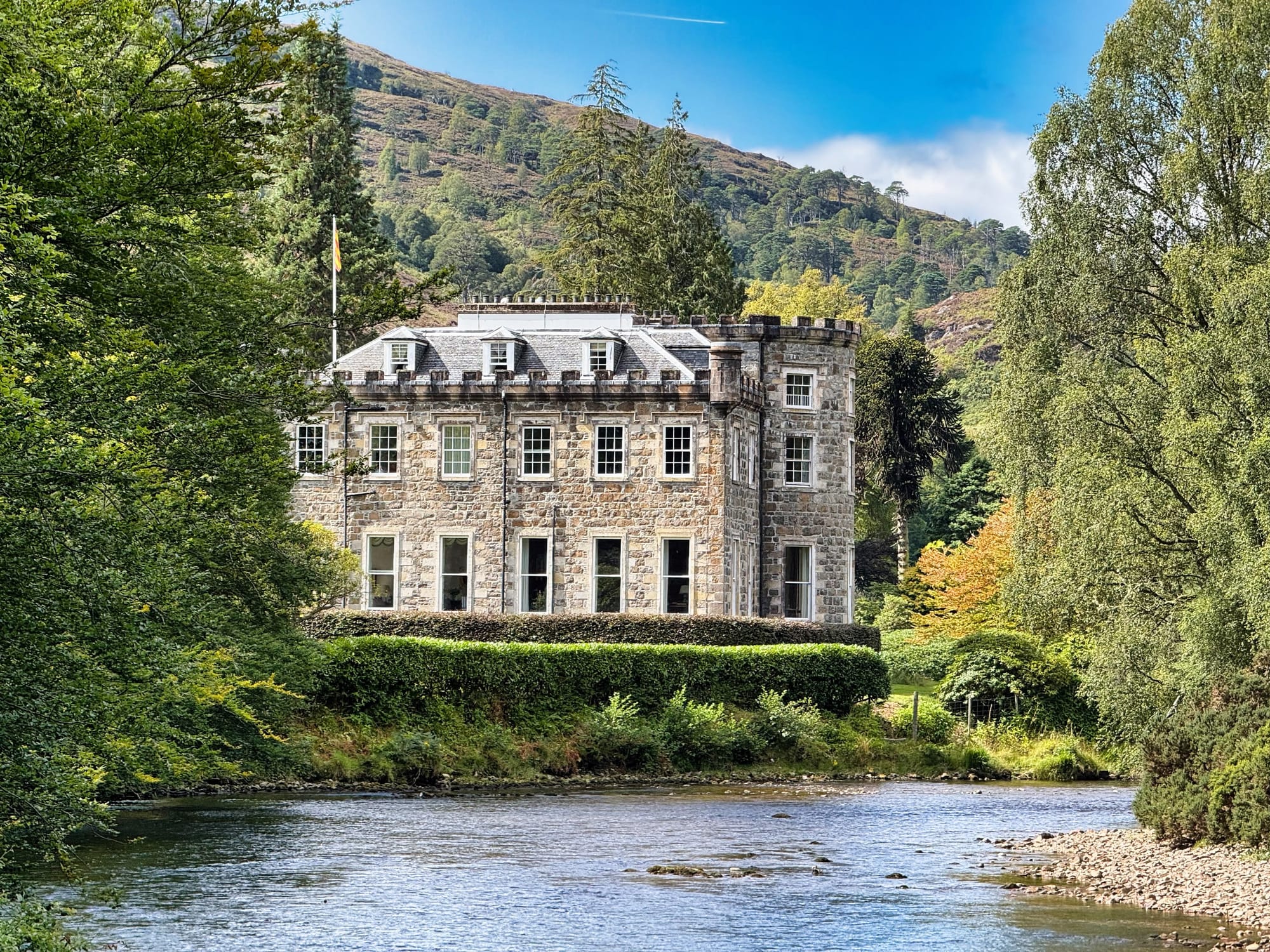
We drove south for two nights at Inverlochy Castle, because Lisa wanted the castle experience. Americans romanticize "castle." We shouldn't. Strip the word away and what you get is an old mansion converted into a fancy hotel, and in this case one that coasts on the architecture. Lisa stood in the grand hall taking the measure of it, decided it was enough, and that was that. Pleasant. Worth doing once.
Glasgow was the last stop. We'd planned ten days and left after six. Nothing wrong with it. Just not much that felt right.
The UK is also expensive. Seventy-five dollars for an unremarkable lunch became normal. A hundred and twenty-five on a bad day. You pay it because you have to.
But comfort is its own kind of value. After months of eavesdropping on conversations we couldn't follow, the simplicity of overhearing English felt like a small gift. The pleasure of a country where everything works in a way you already understand. Where the tourist-y parts are tourist-y in a good way (theatres, scenery, history) and the rest is just people living their lives at a pace you can match.
Not exotic, and wonderful anyway. We'll keep coming back.
Paris—The Trip That Lasted a Day
Paris started out perfectly. Friends were on their way, and we were zipping around the city like kids in a candy store, literally buying chocolate while we waited for them. Crepes, ice cream, pastries, a little shopping, and even a quick stop at the newly reopened Notre Dame. Everything felt easy, light, and good.
Then the call came. Lisa's father had passed away.
A few hours later, we were packing bags instead of picnic baskets. By dawn, we were on a plane to Raleigh. Just like that, Paris was over.
Raleigh—The Funeral and the Marathon
We landed in Raleigh by way of Mount Olive, a little town of five thousand where Lisa grew up. Our first stop wasn't family gatherings or sightseeing: it was helping her mom prepare for the funeral.
It was a heavy week in a small place. Meals came from the highway diner or the Taco Bell down the road. Not exactly a culinary destination, but we got through it. The funeral itself was dignified and moving, complete with military honors. Emotional, yes, but also filled with grace.
With that behind us, we turned to what I can only call our annual medical marathon in Raleigh.
Lisa had her slate of appointments, and I had my own gauntlet: internist, dermatologist, cardiologist, dentist, you name it. Days of nonstop probing, poking, and pouring blood and urine into vials. Results hit my online portal like a flood, and the doctors scrambled to slot in follow-ups as needed.
That first week was nothing but doctors and labs. Only after surviving all that did we finally have space to breathe, and see friends and family.
And then, without much warning, it was time to leave again.
That's how these months work. Grief, bureaucracy, blood tests, reunions, all compressed into a few weeks and then sealed behind a departure gate. We're exhausted when we leave but leaving is hard. We exit with a head full of unfinished conversations, a phone full of fresh medical portals, and the sense that another chapter has closed.
The next flight was already booked. The next continent was already waiting. The grief would have to travel with us, the way grief always does.
Bangkok—The Whiplash
Thirty-eight hours later, the world looked different.
The trip to Bangkok was a marathon in the sky: Raleigh to Chicago, Chicago to Doha, Doha to Bangkok. We left Monday at 1 p.m. and walked out into Bangkok's humidity at 7 a.m. Wednesday.
Somewhere over the Atlantic, time stopped meaning anything. It was that strange long-flight limbo where your entire existence shrinks to two options: watch another movie or fall back asleep. Exhausting, but oddly restful. The distance did something the time in Raleigh couldn't do: it put space between us and what had just happened.
At the airport, our eldest, Toby, was waiting. A few hours later, our youngest joined us for lunch. And just like that, the jet lag didn't matter. We'd been burying someone a week ago. Now we were with our kids. The whiplash is the whole story.
Osaka
After a quick family stop in Bangkok, we hopped a short flight (by our standards) to Osaka. Five and a half hours in the air, followed by what felt like five and a half days in the immigration line.
Japan's tourism boom is real. Some say too real. Even with pre-registration, the wait was glacial. Still, it was Japan, so everyone endured it with quiet patience, except for one guy who snapped and yelled something about a "f***ing arrival card." Otherwise, pure civility.
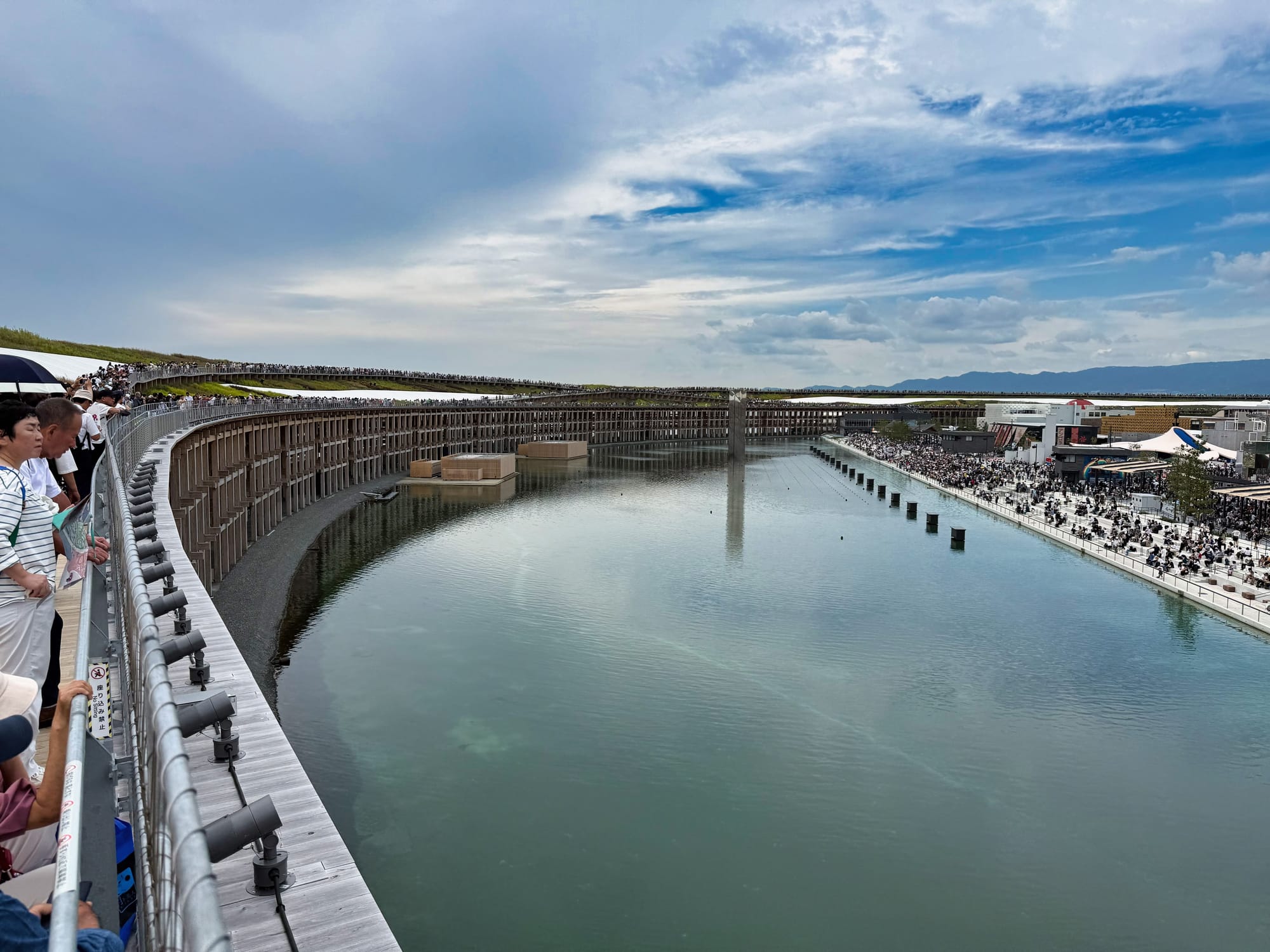
We spent two weeks in Osaka, mostly to see the 2025 World Expo. The good news: it was a massive hit, drawing more than 20 million people. The bad news: 20 million people is way too many to stand in line with. We had three-day passes and called it quits after day one. Maybe we'll try the 2030 Expo in Riyadh, if we forget how this one felt.
Osaka itself, though, was a joy. A nonstop buffet of sushi, ramen, soba, and okonomiyaki. The city never runs out of spectacle. By day, it's a crush of tourists; by night, neon lights, costumes, and chaos.
Smaller than Tokyo, but somehow just as endless. We love it.
Tokyo
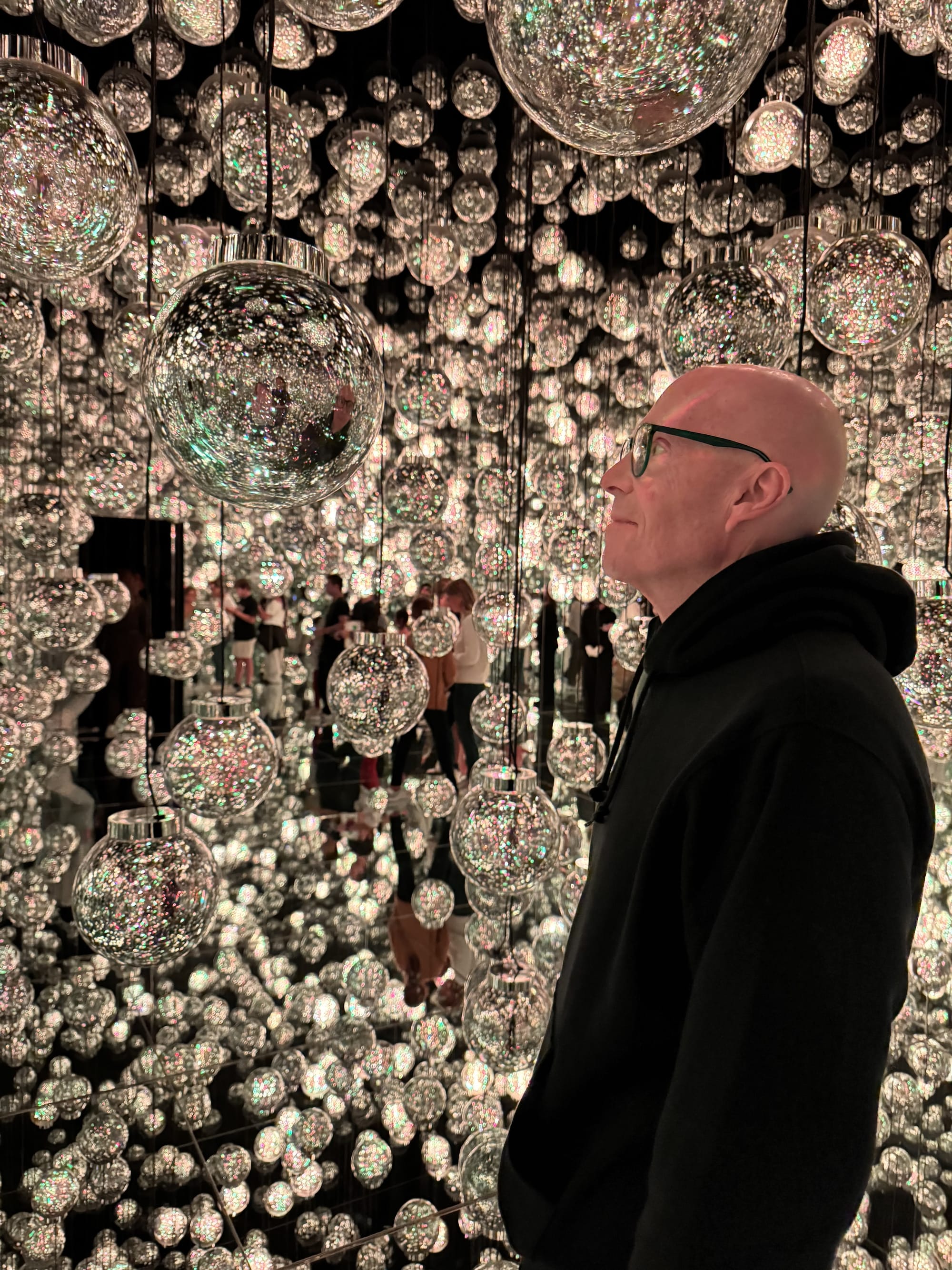
I stumbled backward into the people behind me when an old man shoved me in the Tokyo metro. He wasn't being rude, just determined. Rush hour in Tokyo is a team sport. Thousands of people pressing forward, shoulder to shoulder, head to foot. I still don't know how the small children survive it. Maybe there's more room down there below waist level.
And yet, five minutes after stepping off the train, you can find yourself walking alone through a quiet neighborhood: narrow streets, tidy houses, front doors practically brushing the edge of the pavement. It's peaceful. Perfectly still. And almost always raining. Tokyo gets twice as much rain as London or Paris, but somehow that never makes the travel brochures.
What makes Tokyo great is the mix: impossibly dense, yet endlessly orderly. Everything just works. The trains, the restaurants, the vending machines that somehow always have your favorite drink in stock. There's a process for everything, and everyone plays their part. It's civilization running at peak performance.
And then there's the imagination of the place. Whatever you can think of, Tokyo has already built it. Maid cafés? Check. Cat cafés? Of course. Model train bars? Several. Ham radio clubs, robot restaurants, art museums, Michelin-starred sushi counters, Disney parks, and more themed experiences than you could dream up in a lifetime. The city runs on creativity and caffeine.
We were there for six days. Lane flew in from Bangkok to join us, and together we walked tens of thousands of steps every day, because that's what you do in Tokyo. You walk, you watch, and you wonder how the biggest city in the world can feel so alive and yet so strangely calm.
Hiroshima
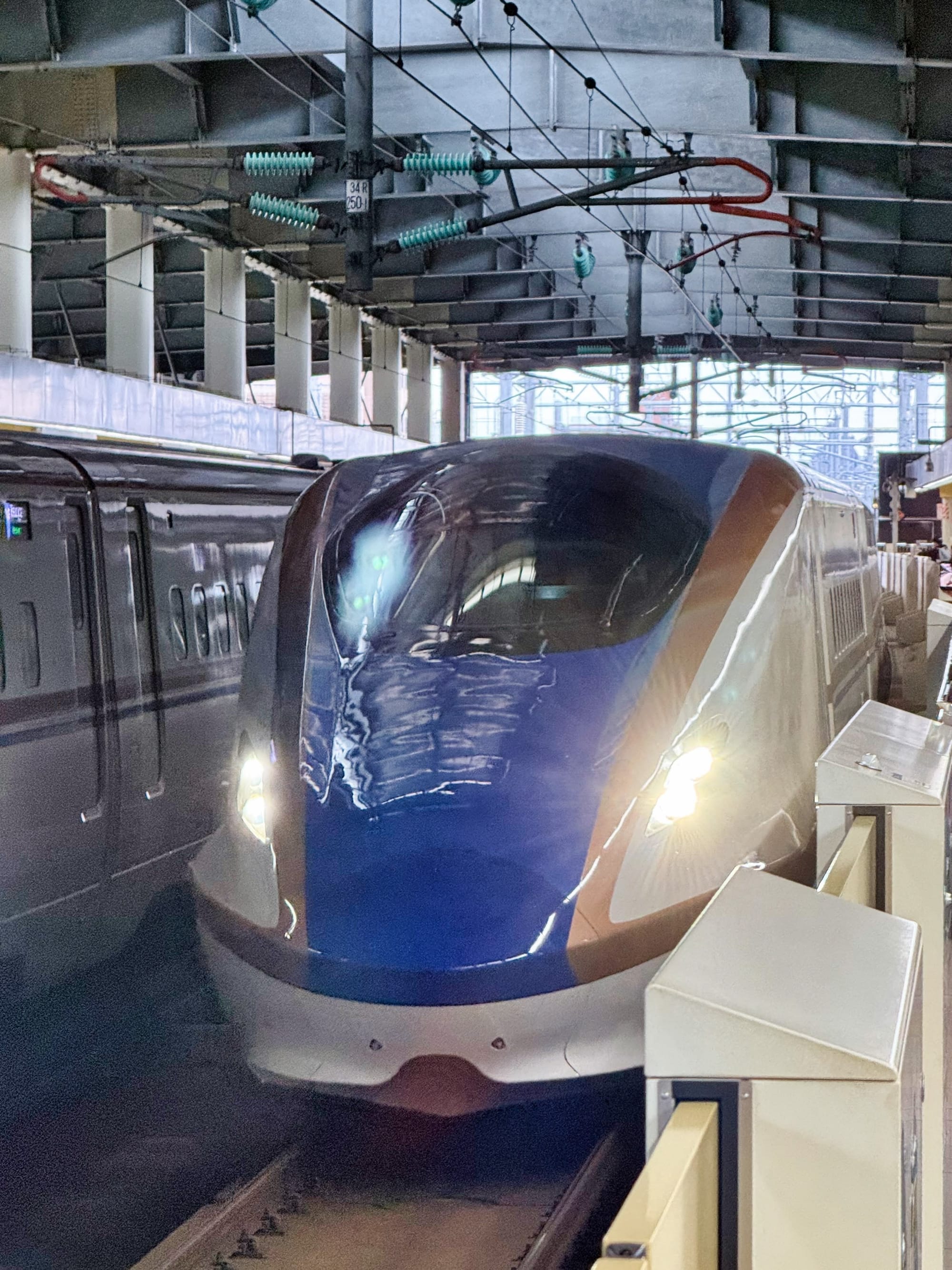
We slid out of Tokyo on the shinkansen, a silver whisper over rails. Mt. Fuji flashed by—snow-capped, perfectly framed, the kind of view that makes the whole car go quiet.
Hiroshima is easy to reach and impossible to carry lightly.
We checked into the ANA Crowne Plaza, two blocks from the hypocenter. Breakfast at 7:20 became a ritual. Each morning the language shifted with the tour groups: UK accents, Australians, German, French, Chinese, Americans. Name tags, rolling bags, a quick assault on the buffet, then the room emptied as buses swallowed everyone for their one-night stop. We'd run into them again in Peace Park, the same faces, now hushed. It can feel awkward: grief on a schedule. Still, it's good they come. Awkward beats absent.
Peace Memorial Park is quiet until it isn't. We stood at the Children's Peace Monument while a middle school choir sang from across the river. Eerie. Intense. Powerful. Sound carried like cold air. You could feel it.
The facts don't need help: students digging firebreaks that morning; an instant later, erased. Tens of thousands gone, many more following. The mind hunts for a neat box. There isn't one.
The city wears its grief with restraint. I don't. I wanted to wail, and the place asks for a bow. So I bowed. Then I went back the next day and bowed again.
We'd been before and knew it was our kind of city: rivers curling through neighborhoods, generous parks, easy walking, friendly noise. There's a ghostly presence that settles in as the days stack up. Tourists add a hum that makes it livable, even tender.
We ate a lot of sushi. Then we found three pizza spots that could hold their own in Naples. Yes, Naples. The Japanese don't mess around with perfection (hydration, fermentation, blistered leoparding, the ritual of getting it right). It's craft as apology and celebration at once.
Stay long enough and the weight finds you. It arrives as gravity, not as blame. You walk the river, read the placards, talk less. You let the silence do its job. Then you go to a meal, talk too loud, catch yourself, and try again tomorrow.
Okinawa
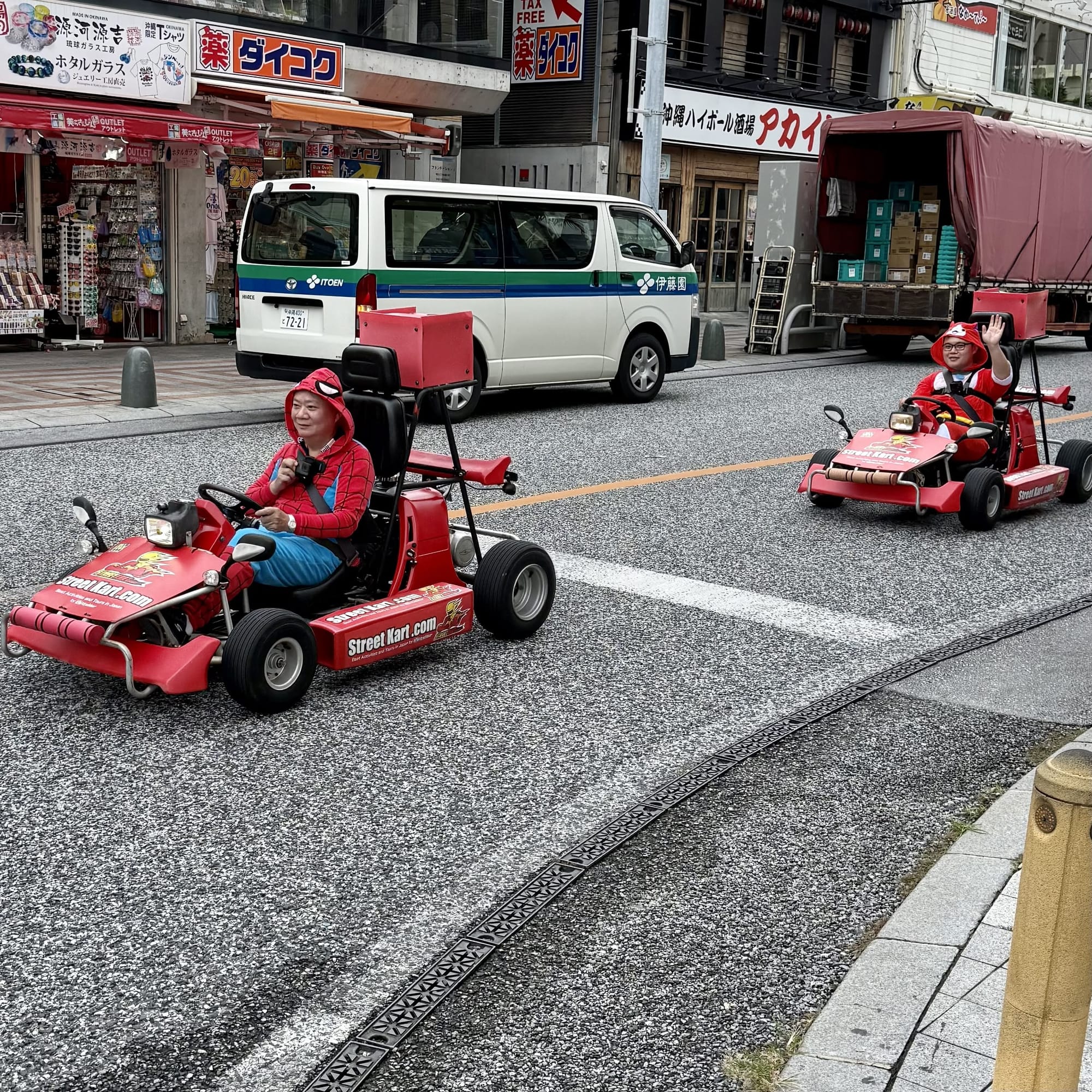
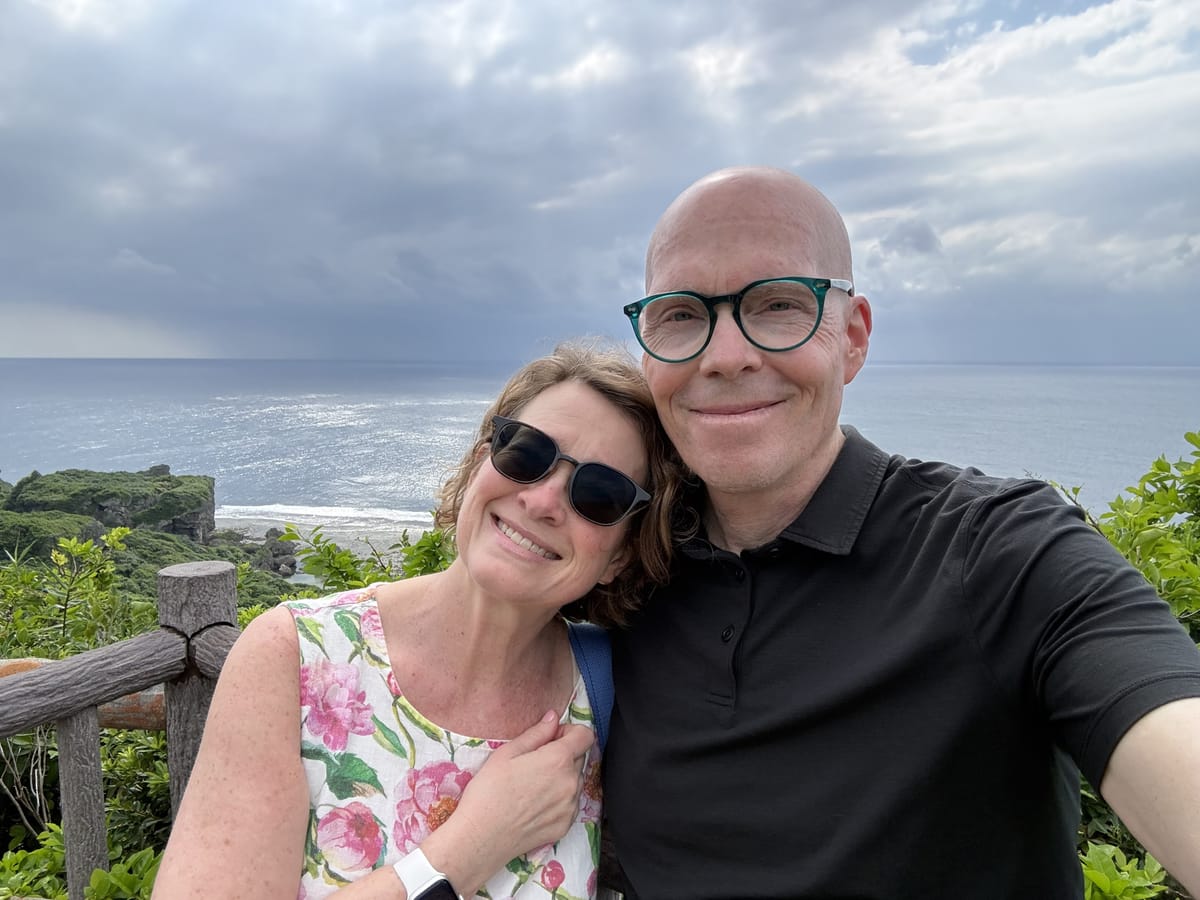
From Hiroshima, we hopped a short flight down to Okinawa and picked up a rental car, one of the best decisions we've made in Japan. Having wheels here completely changes the experience. You're suddenly free to wander the coastline, dip into tiny towns, and chase whatever catches your eye.
And because it's Japan, of course everything works. The roads are immaculate. The food is outstanding. The nature is pristine in that almost comically Japanese way: beaches scrubbed clean, forests quiet and orderly, even the parking lots look like someone tidied them before we arrived.
But the real surprise in Okinawa isn't the scenery. It's the story the island tells.
We've seen war history all over the world (Vietnam, Cambodia, Lebanon, Africa, Europe, the Middle East). And the pattern is always the same: the narrative leans toward the victor. The winners are noble, the losers are villains, and the museum plaques make sure you leave believing exactly that.
Okinawa breaks that pattern.
Here, everyone is the villain.
The museums lay it all bare: the brutality of the Japanese military toward Okinawans, the devastation brought by the Americans during the Battle of Okinawa, the civilians trapped in between with nowhere to run. No clean heroes. No sanitizing of motives. No tidy moral arc.
Just tragedy all around, told without flinching.
It's startling. And oddly refreshing.
Where you expect nationalism, you get humility, and where you expect triumph, you get grief. Threaded through every exhibit and every monument is one message: peace is the only acceptable outcome of war.
It's an unusual stance. Almost radical. And it stays with you long after you leave the museum, long after you're back in the car, driving past perfect beaches and bright blue water, wondering why more places don't tell the truth this way.
Then we spent our last four nights in an oceanfront hotel next to a United States Air Force base.
Most mornings started the same way: the calm of the sea, soft light on the water, coffee in hand. And then the sky would rip open.
Fighter jets came roaring overhead, low and loud enough to rattle the windows and shake your chest. Conversations stopped mid-sentence. There's no "talking over" that kind of noise. You just sit there and feel it.
These machines aren't theoretical. You can see the power in the way they move—banking, diving, climbing hard, running practice formations out over that same bright blue water. You don't need much imagination to picture what it would be like if they weren't just practicing.
It's impressive, in a way. And terrifying.
Watching them, you can't help but think about the civilians who once stood on this island, looking up at a sky full of planes that weren't rehearsing. What does it do to a place to carry that memory in its soil while war machines still scream over its beaches before breakfast?
Inside the museums, the message is simple and relentless: never again. Peace is the only answer.
Outside, the sky is still training for the opposite.
Okinawa is beautiful. But it also feels honest. And that honesty includes the contradiction: the island begging for peace while the jets overhead remind you that the world isn't listening nearly as closely as it should.
Bangkok—The Homing Signal
We dropped into Bangkok for five nights. Just a quick dip. Long enough to hug the kids, buy them lunch, remind them we exist, then get out before anyone gets twitchy about extended parental presence.
That's become our Bangkok rhythm: drop in, reset, move on. It's our version of a homing signal. The city is the pause button we hit whenever we're circling Southeast Asia.
And somehow, every time we're there, we end up running errands like we actually live there. This round, I saw a podiatrist because a small bump on my foot decided to audition for a speaking role. When you walk as much as we do, ignoring a foot problem is like ignoring a leak in a boat: you pretend it's fine right up until you sink.
After the appointment, I made the brilliant decision to walk back to the hotel. Two hours on Google Maps. One hour before my brain melted. Bangkok heat doesn't play around. It creeps up your spine, whispers "you're an idiot," and then smacks you with another five degrees.
Even so, that walk, before I surrendered to climate reality, was the usual Bangkok buffet of surprises. A gleaming Buddhist temple that looks dropped in by a celestial crane. A stretch of the river where old women sell snacks you can't identify but absolutely want to eat. And whole neighborhoods pressed so tight against the railroad tracks that you could lean out of bed and high-five the conductor.
The range of how people live in this city is a whole spectrum unto itself. Tiny stacked rooms. High-rise luxury towers. River shacks on stilts. It's all crammed together in a way that shouldn't work, and yet it does. And somehow, in all that density, almost nobody is sleeping rough. It's one of the few mega-cities where you don't feel the dull ache of homelessness on every corner.
When the heat finally broke me, the city caught me. Bangkok always does. The trains are fast, clean, and cold enough to store meat. And when the trains don't go where you're going, Grab will, usually for the price of a latte.
Bangkok is the place we slide in and out of, a city that always shows us something new even when we swear we're just here for a quick hello. Five nights, a couple of hugs, a podiatry tune-up, and a walk that reminded me I'm not 25 anymore.
Perfect. Ready for the next stop.
Koh Libong
Getting to Koh Libong feels like an initiation ritual. A Grab to the airport. A plane. An SUV. A long-tail boat. And then a pickup truck with benches in the back, because apparently that's the official welcome wagon of every Thai island.
But the roads here? Shockingly good. No potholes. No chaos. The main roads are brick (actual decorative brick) laid out like someone hired an artist instead of a road crew. After the journey it takes to get here, it almost feels like a prank. You expect mud, goats, and broken concrete. Instead you get charming brickwork.
The island itself is quiet. Spread out. Peaceful. And Muslim, which catches most visitors off guard because Thailand is overwhelmingly Buddhist.
It means you hear the call to prayer drifting across the island five times a day, which adds a whole different texture to the place. You don't expect it in Thailand, but once you settle into the rhythm, it feels like part of the soundtrack of the island.
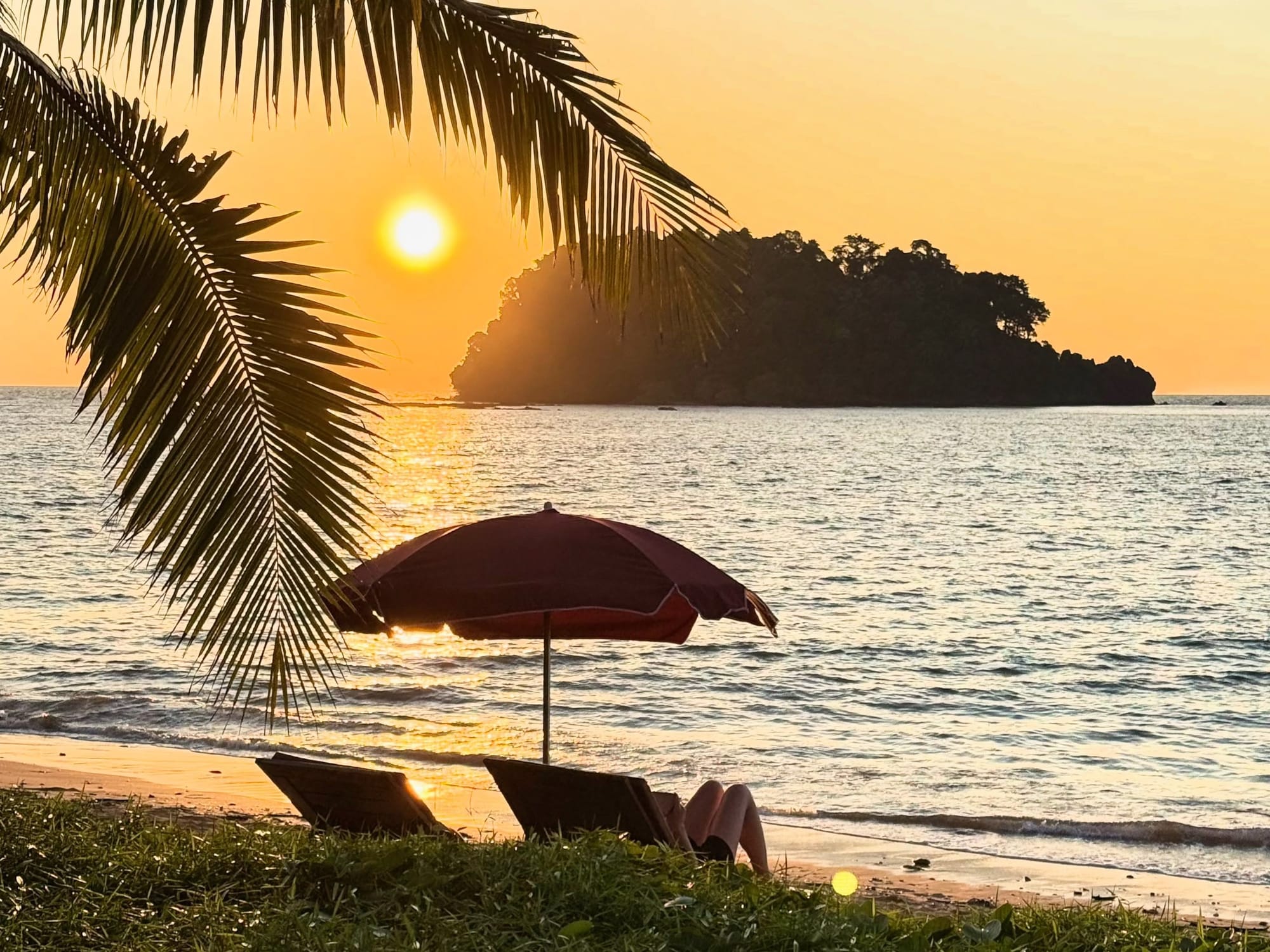
We're staying at a place that lands somewhere between "beachy and simple" and "electricity available when the universe is in the mood." The power comes and goes. The internet comes and goes. The beach is mostly clean, the sunsets knock you backwards, and two weeks feels exactly right: long enough to slow down, short enough that we don't start naming the stray dogs.
What you notice here is how cheap it all is. Laundry is six dollars for a week's worth of clothes, charged by the bag. Six dollars. You'll start looking for excuses to wash things.
Koh Libong isn't flashy. It doesn't try to impress you. It just quietly works its way under your skin. Brick roads, call to prayer, quiet beaches, cheap laundry, and sunsets that turn you into a philosopher.
Not a bad trade for a five-stage journey.
Chennai, India
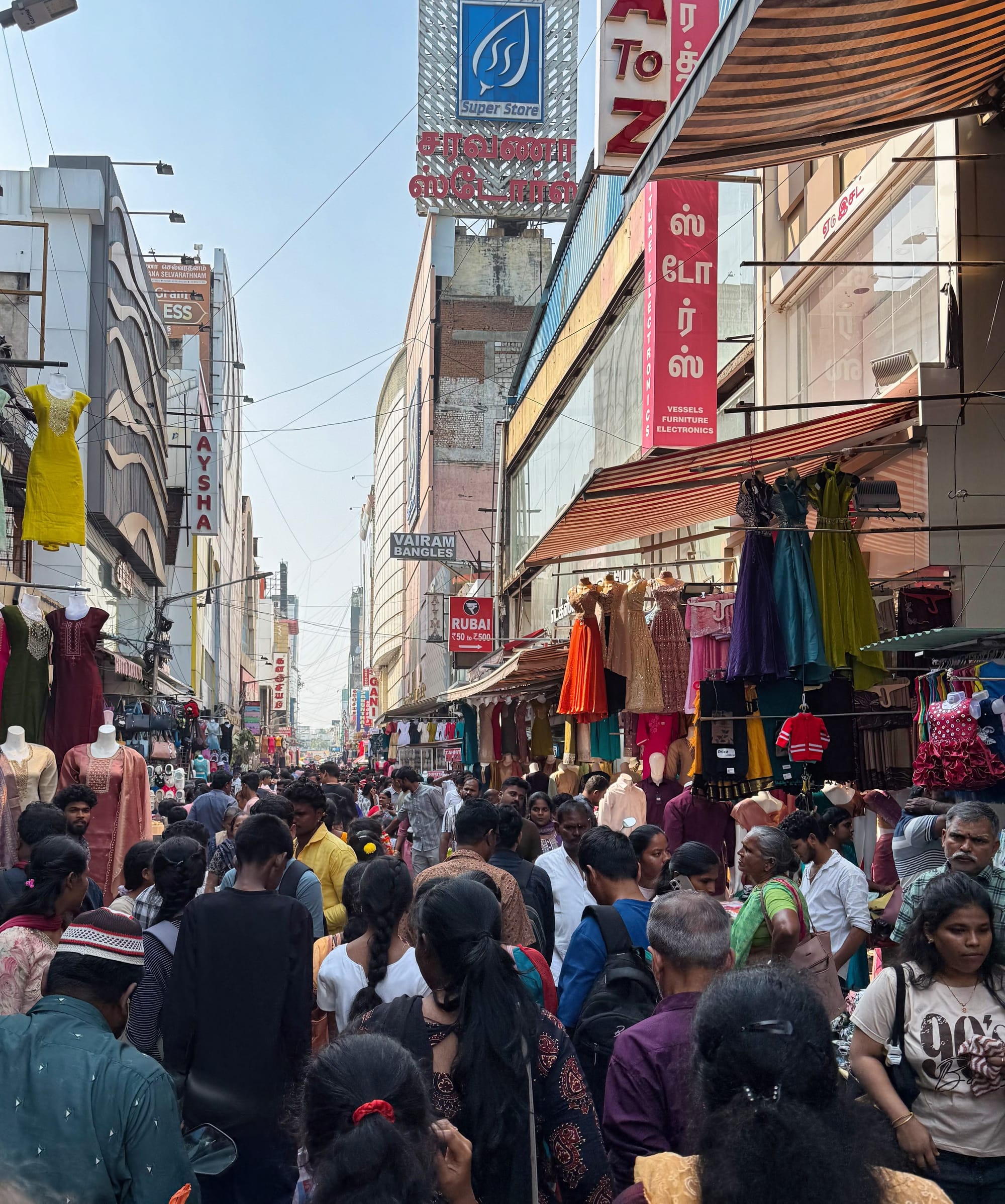
We'd seen big cities all year. India dwarfs them somehow.
Start with the friction.
It's crowded in a way that presses on your nervous system. Twelve million people is considered modest here, which sounds abstract until you're standing at a curb trying to cross the street. Sidewalks break off mid-stride. Holes appear where pavement should be. Wires droop low enough to make you duck. Walking isn't passive; it's participatory, full contact.
Traffic fills every inch. Cars, buses, motorbikes, auto rickshaws: layered, braided, negotiated in motion. Horns are constant. They aren't angry, they're informational, a running commentary on presence. Restaurants add their own soundtrack: packed rooms, voices overlapping, plates clattering. Silence is not part of the plan.
Then there's the air. Heavy. Dusty. Persistent. Limited public budgets show up everywhere: maintenance deferred, systems strained, standards uneven. This is not a city optimized for ease.
And yet.
The people are extraordinary.
Everyone talks. Everyone helps. Everyone explains. The table next to you joins the meal. Waiters drift over to demonstrate, not to hurry you, how something is meant to be eaten, mixed, enjoyed.
In Chennai, eating with your hands is just how it's done, and someone will happily show you how, generous and unselfconscious about it.
Then there's the food.
At one end, there are polished dining rooms—gourmet décor, tasting menus, service that would hold up anywhere. At the other, meals that cost a dollar or two and deliver joy with ruthless efficiency. The whole range, with nothing compromised at either end.
So how do you live with the chaos?
You buy your exits.
India is shockingly inexpensive if you spend with intention. On this visit, the Park Hyatt Chennai is our refuge, priced like a forgettable Hyatt Place back home, functioning like a decompression chamber. Ubers cost a couple of dollars. Lunch for two might cost three or four. Long lunches become recovery periods. The hotel becomes the quiet between waves.
You need that here.
Between the noise, the animals threading through traffic, the visual overload, and the constant negotiation for space, India demands downtime. Pretending otherwise is bravado.
Enter my mother, eighty-seven
And then we add a variable.
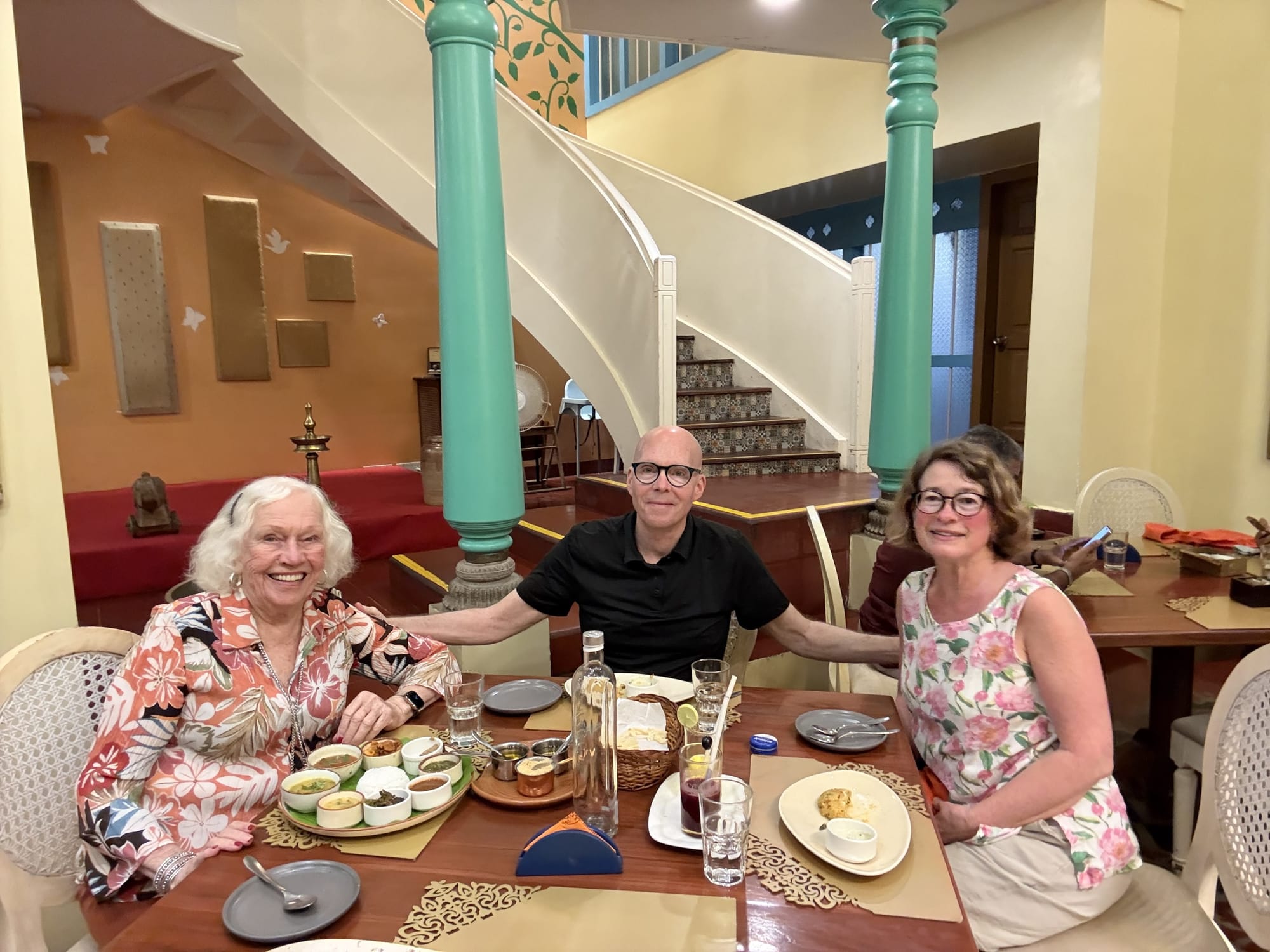
For the third week, my mother joins us. She arrived by cruise ship—around Africa, then up to India—before stepping into this city with us. It's not her first time in India, but it is her first at age eighty-seven.
Which changes everything.
Pace slows. Awareness sharpens. Street crossings become more deliberate. Chaos becomes louder when you're listening for someone else. And at the same time, the city opens up. Conversations last longer. Explanations get better. Watching someone else experience India—again, but differently—adds a layer of joy that offsets the added logistics.
That's the thing about this place. It stretches you. Then, if you're smart, it gives you somewhere to sit down.
India rewards slowness. Punishes haste.
Spend your money where it buys relief, and you get the people, the food, the conversations, without being crushed by the weight of it all.
The Long Road to the Tigers
We left Chennai and flew north to Delhi, then climbed, slowly, brutally, toward Jim Corbett National Park.
On a map, it's nothing. In real life, it's seven and a half hours of sustained assault.
The drive out of Delhi is chaos layered on chaos. Traffic is packed so tightly it feels interlocked. The road surface oscillates between cracked pavement and something closer to churned earth. You cross the Ganges and see funeral rituals underway at the water's edge. You pass through market towns where people are inches from your window, selling, repairing, hauling, standing, while trucks, scooters, cows, and pedestrians all claim equal priority.
It rained the entire way turning dust into slurry and making every mile feel conditional.
By the time we reached the Marriott near Ramnagar, we were exhausted. And immediately disoriented by the contrast.
The grounds were calm. The rooms immaculate. The staff: uniformly, relentlessly kind. This isn't a place that sees many foreign tourists, and it shows. Managers came out to greet us. Hands were shaken. Names remembered. You get the faintly uncomfortable sense of being important without having done anything to earn it.
That night felt like a suspension between two realities.
The next morning erased that illusion.
Cold, wet, and waiting
Safari mornings start early. Earlier than feels reasonable.
By 5:45 a.m. we were layered up and climbing into a government-issued open jeep, canvas top stretched overhead in a gesture that was more symbolic than functional. The forty-minute drive into the park was cold and wet. When the jeep shifted, water poured in through the seams. When it stopped, it pooled. By the time we reached the forest, my back and seat were soaked through.
We spent five hours out there that first morning and saw almost nothing. Rain shuts Corbett down. Animals retreat. Birds disappear. You hunch, shiver, and quietly question your judgment. We saw spotted deer, sambar, a few birds, and an awful lot of mud.
Lunch back at the hotel felt like a consolation prize.
Then the weather turned.
That afternoon the rain stopped, the forest opened up, and everything changed. Four and a half hours in, we saw our first tiger.
Then a second.
A male walked past our jeep, fifteen feet away, close enough to hear him breathing. A female followed. They called to each other, low and resonant, moving with purpose. It was unmistakably a mating ritual. And it was overwhelming.
Every miserable, frozen, rain-soaked minute from earlier in the day disappeared on the spot.
This is the Corbett bargain: prolonged discomfort in exchange for a few minutes of absolute clarity.
Six tigers, one close call

The next three days followed a predictable pattern.
Every morning, before climbing back into the jeep, we had second thoughts. It was cold. Sitting still for nine or ten hours in an open vehicle is not pleasant. The seats are hard. The wind cuts through you. The payoff is never guaranteed.
Most people come to Corbett and never see a tiger. The forest is dense, the undergrowth thick, and the cats have no interest in being visible. You're supposed to appreciate the landscape, the anticipation, the possibility.
We got absurdly lucky.
We saw a tiger every single day. Six in total.
The last one nearly ended the trip very differently.
At one point, a tiger found itself boxed in between our jeep and another vehicle. The space narrowed. The tiger crouched, muscles coiling. For a brief, very real moment, it felt entirely plausible that she might leap, toward us, toward Lisa, toward something catastrophic.
Then both vehicles moved at once. The tiger surged between us and vanished into the brush.
It was frightening. It was electric. It felt like exactly the right note to end on.
The room that broke me
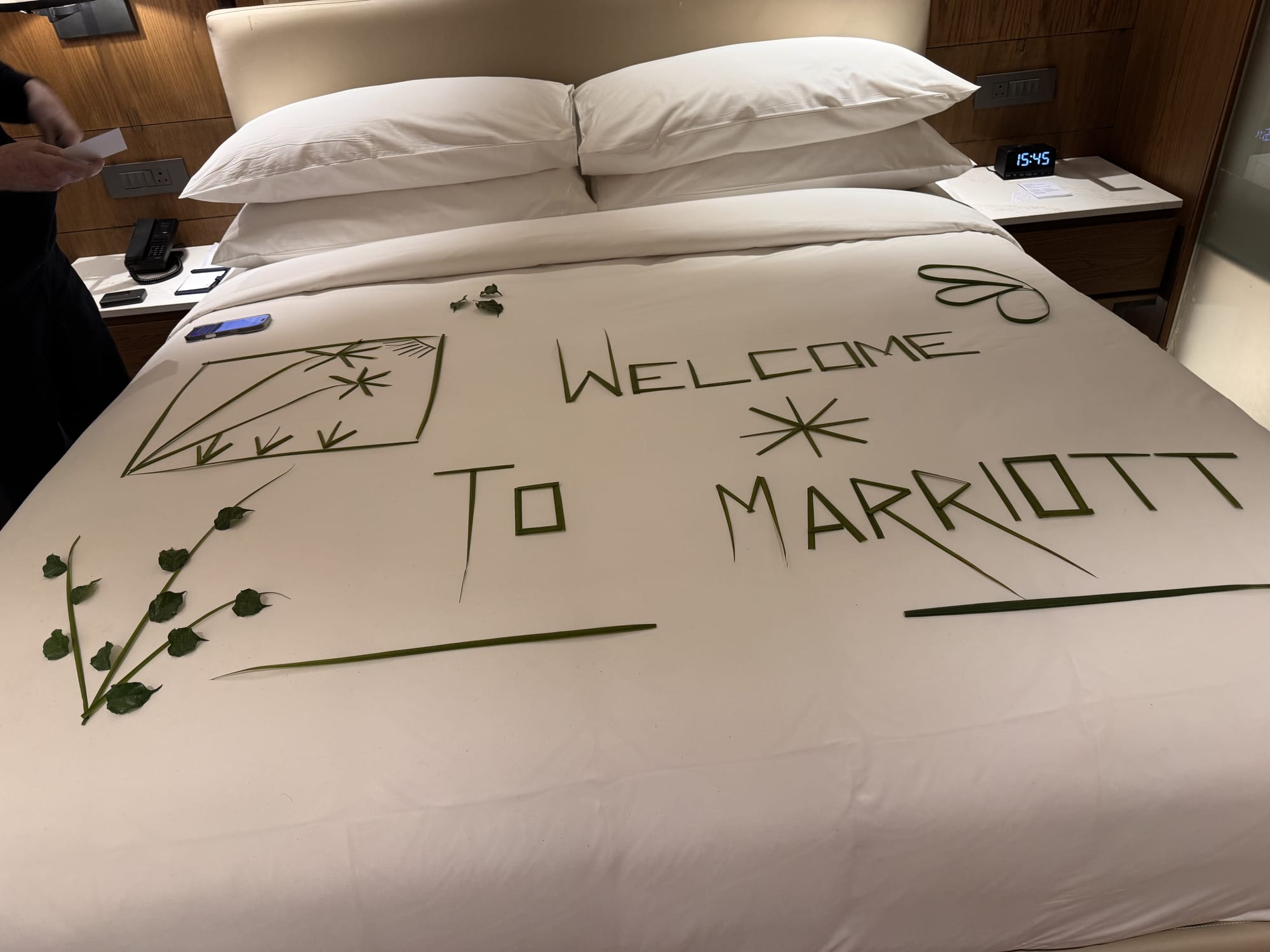
Every day at the Marriott, housekeeping transformed our room.
Towel animals. Palm fronds arranged into words. Handwritten notes. Small bowls of almonds. And every day, they asked, earnestly, if we were enjoying it. If everything was to our liking. If there was anything more they could do.
It was constant. Over the top. Clearly a source of pride.
On our final night, we were packing for an early departure. Out of habit, I cleared the bed. Swept away the leaves. Broke down the display without a second thought.
A few minutes later, two housekeeping staff knocked on the door.
They asked if they could take a selfie with us.
Then it became clear what they wanted: the photo in front of the bed decoration. The thing that no longer existed. All that remained were two towel animals, separated from whatever larger idea they'd been part of.
One of them looked genuinely crestfallen.
These were men who spoke excellent English. Who had checked in on us every day. Who had worked carefully and creatively all week to impress us. And we, comfortable, transient, jaded, had erased the evidence without even noticing.
We couldn't put it back. The leaves were gone. The moment was gone.
We took the picture anyway. We thanked them. We told them how much we appreciated everything.
It still sat heavy.
It still does.
India, without a buffer
The breakfast buffet the next morning was spectacular, Indian, Western, everything, though we barely had time to register it before the long drive back to Delhi. Rain again. Traffic again. Driving that feels genuinely dangerous whether you're in a jeep or a luxury SUV.
We made it back. Spent the night. Our flight the next morning was delayed: rain and pollution trapping visibility in a gray blur. Eventually, we left.
Seeing the tigers was extraordinary.
But what stayed with me was something else.
India hits differently because you can talk to people. The drivers. The guides. The housekeeping staff. They speak English. They joke. They explain their lives. And that makes inequality impossible to abstract away.
You don't just see hardship here. You understand it.
There was a lavish wedding at the hotel while we stayed. A Rotary conference the last two days—men in suits, families in tow, motivational speeches echoing through the halls. Celebration layered directly on top of struggle.
It's emotionally exhausting. It's deeply inspiring. It refuses to resolve neatly.
And maybe that's the point.
Bangkok—Finding the Nomads
We dropped back into Bangkok after India the way you return to a charging cable: instinctively, gratefully, without making a big deal of it. Ten days, the kids, the usual reset. But this visit had something the others didn't.
Bangkok is one of the world's great nomad hubs. Inexpensive, well-connected, excellent food, a place where the basics don't fight you. There's a constant stream of meetups in coffee shops and bars, lunches organized by strangers who happen to share a lifestyle. We went to one. Within ten minutes we were trading stories with people we'd never met about visa runs, favorite cities, and which neighborhoods had the best internet for the price. You can't have that conversation with tourists on vacation, whose entire frame of reference is two weeks off from their real life. Nomads aren't on vacation. This is their life. They ask different questions, and the answers are actually useful.
Then Lane introduced us to a couple about our age, from North Carolina, whose wife went to the same college as Lisa. Suddenly we were at dinner talking about people we might both know, which is not what you expect to find in Bangkok on a Tuesday. We packed up still turning that over, and headed for China.
Shenzhen
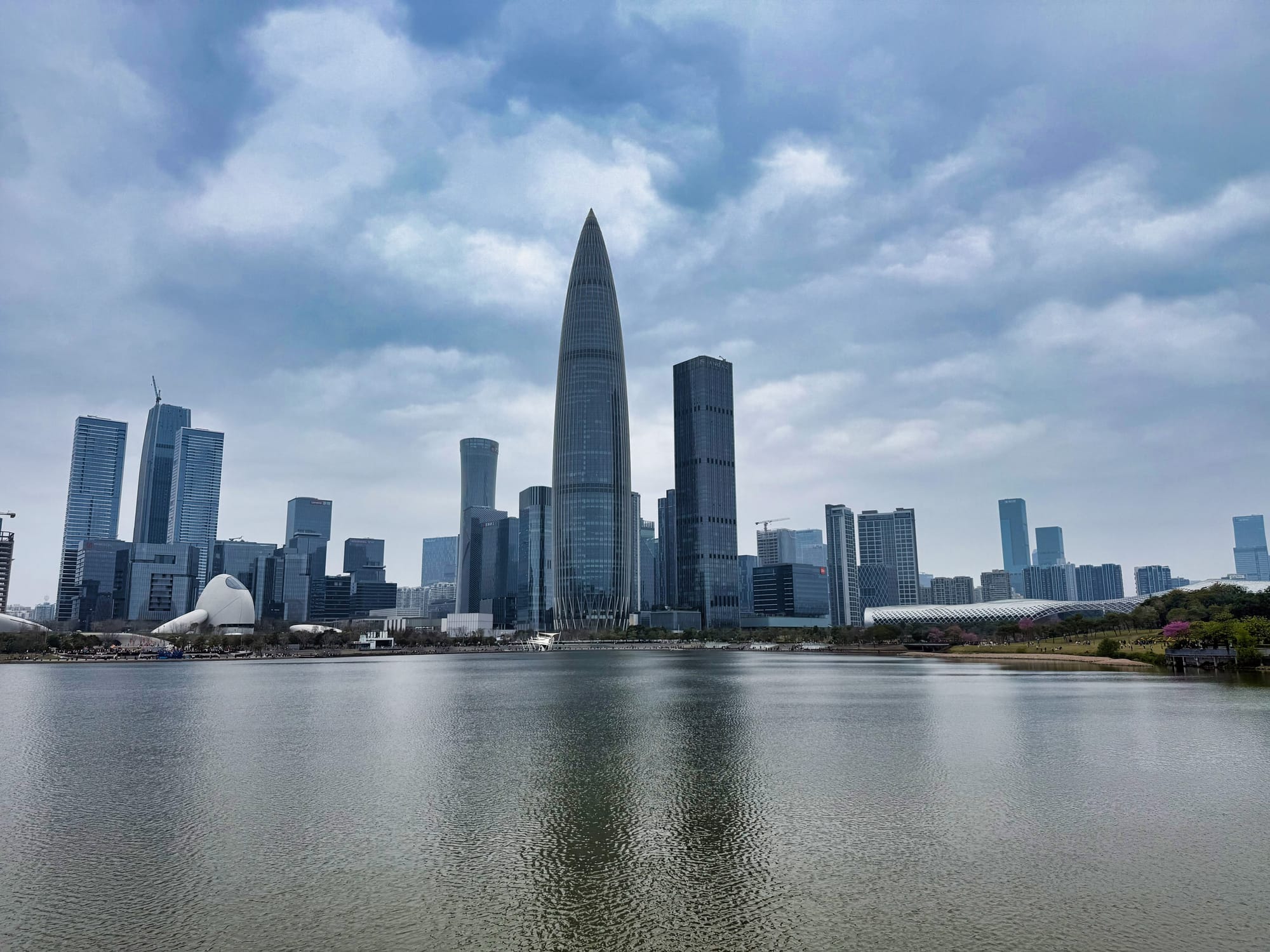
We flew from Bangkok into Shenzhen for 18 nights. We'd never been to that part of China having spent our previous visits in more popular tourist destinations.
There was no plan. We were just curious. Shenzhen is China's Silicon Valley: a technology and manufacturing machine with a reputation large enough to feel abstract from the outside. We wanted to see it from the inside.
We checked into the Crowne Plaza in Nanshan, high up in a nearly 50-story building, and looked out the window.
The skyline doesn't behave like a skyline. It's not one downtown core with a few towers asserting themselves; it's clusters, dense knots of skyscrapers scattered in every direction, as if the city couldn't pick a center and just built several. Over 17 million people, and from up here it looks like every one of them needed their own tower.
At night the clusters don't just light up. They perform. Right outside our window, four towers run a connected light show, colors moving from one building to the next, synchronized like the city is playing Tetris with itself at scale, and the same thing is happening across the entire view, hundreds of buildings all on the same network. It's mesmerizing and slightly unsettling, a city that can't help demonstrating what it's capable of.
The quiet at street level
The first thing I noticed at street level wasn't the scale.
It was the quiet.
Electric cars. Electric motorbikes. Scooters sliding down sidewalks in complete silence, close enough to part your hair. You learn very quickly to walk like you're sharing space with things you cannot hear.
Arrive from Bangkok and the contrast is immediate. Bangkok is loud even when it's resting: traffic, engines, the roar under the elevated metro stations that never fully stops. Shenzhen is turned down many notches. On the metro, people aren't performing. The mood is subdued, almost private. A city of millions that somehow doesn't feel like it's competing for your attention.
We arrived just before Lunar New Year, which added a layer: people leaving town to visit family, the city draining by the day. Streets that should have been chaos simply weren't. A megacity running at half the usual volume, which only amplified the quiet that was apparently already there.
Our first meal was dim sum. Seven items. Every one of them a generous serving. We ordered with the confidence of people who had not yet learned what "generous" means in this context, ate nearly all of it anyway, and didn't need to think about food again for the better part of a day.
The bill was $15. Not cheap for what it was. Just cheap.
Old Shenzhen, which is to say last month
We explored what passes for "old" in a city that feels like it was built last week: buildings that look historic until you get close enough to suspect they're just styled that way. The real texture is at street level, older apartment blocks with small shops underneath, people at tables outside with bowls of soup, laundromats tucked in alongside noodle counters and phone repair stalls. We did our laundry there. Nothing romantic about it. Then there's Huaqiangbei, the electronics market, less a market than a philosophical statement about what happens when an entire city specializes in one thing: floors and floors of components, cables, and gadgets you can't identify but feel like you should own.
Drones, drones, and more drones
The Lunar New Year celebrations arrived with a drone show that made every fireworks display we've ever seen feel slightly embarrassed about itself. Many drones, maybe more than a thousand, moving in formation over the city, drawing shapes in the sky, transforming into animals and patterns and messages. Precise. Silent. Coordinated. Deeply, almost aggressively Chinese in its ambition.
And then there were the drones delivering food. Delivery drones humming through the sky.
There was a feeling in Shenzhen that took a few days to name. Walking back to the hotel one night past towers running their synchronized light show, I felt small in a way I hadn't felt small anywhere else. Not the smallness of a tourist but the smallness of getting older, except it wasn't only me aging. The place I came from felt like it was aging too, and somebody else was building the future now.
And smaller than that, in a way that had nothing to do with age. In China you disappear. We knew no one, and no one cared that we were there, except the occasional Western tourist registering another of his own kind across a hotel breakfast room. The rest of the time there's a distance between you and the people around you that's genuinely hard to break through. They're busy. They speak their own language. They are talking to the other billion and a half. You are not lonesome, exactly. You are simply visiting alone: from the breakfast buffet to the tourist sites, out on the street, in the back seat of the Didi. The liminal space I opened this whole thing talking about is never easier to feel than when you are almost a ghost, drifting through a country that doesn't need you and barely registers that you came.
Shenzhen wasn't what we expected, mostly because we didn't know what to expect. It isn't charming in the way old European cities are charming. It isn't chaotic in the way South Asian cities are chaotic. It's something else: enormous, quiet, organized, and quietly proud of what it's built in an extraordinarily short period of time.
We left impressed.
Guilin
We arrived in Guilin by high-speed train from Shenzhen, and the karsts started announcing themselves before we even pulled into the station. Through the window, the landscape just changes—limestone peaks rising out of flat ground like something a child drew and forgot to erase. You've seen the pictures. The pictures are not lying.
The city itself is bigger than you expect. China keeps doing that. You think you're heading somewhere modest and you arrive in a metropolis. Population estimates depend on how you draw the lines, but the lines are always bigger than you imagined.
The next morning we got on the boat.
The Li River runs about three and a half hours from Guilin down to Yangshuo, and the boats travel it in a slow convoy—one after another after another, a long procession moving through one of the most photographed landscapes on earth.
It's peaceful, in the way that something can be peaceful while also being extremely organized and moderately crowded. This was the slow season. I cannot fully picture peak season. Chinese domestic tourism operates at a scale that defies the usual categories. These aren't a few boats on a quiet river. It's a river full of boats, all moving in the same direction, all full of people eating the buffet lunch and staring at the same karsts.
We were two of a few thousand on the water that morning and among the only ones, as far as we could tell, who weren't Chinese. Nobody was unkind. Nobody was anything. We were scenery to them the way the karsts were scenery to us: present, unremarkable, not requiring a response. A crowd that size, and you can still be a ghost inside it.
And the karsts deserve the staring.
Photos compress them. In person, they have depth and atmosphere: mist settling in the gaps between peaks, green coming down the slopes to the waterline, the river reflecting all of it. You sit on the deck and the scenery just keeps arriving, one bend after another, for hours.
The buffet was good. The drinks were cold. By Yangshuo, we were ready to stay a while.
Yangshuo
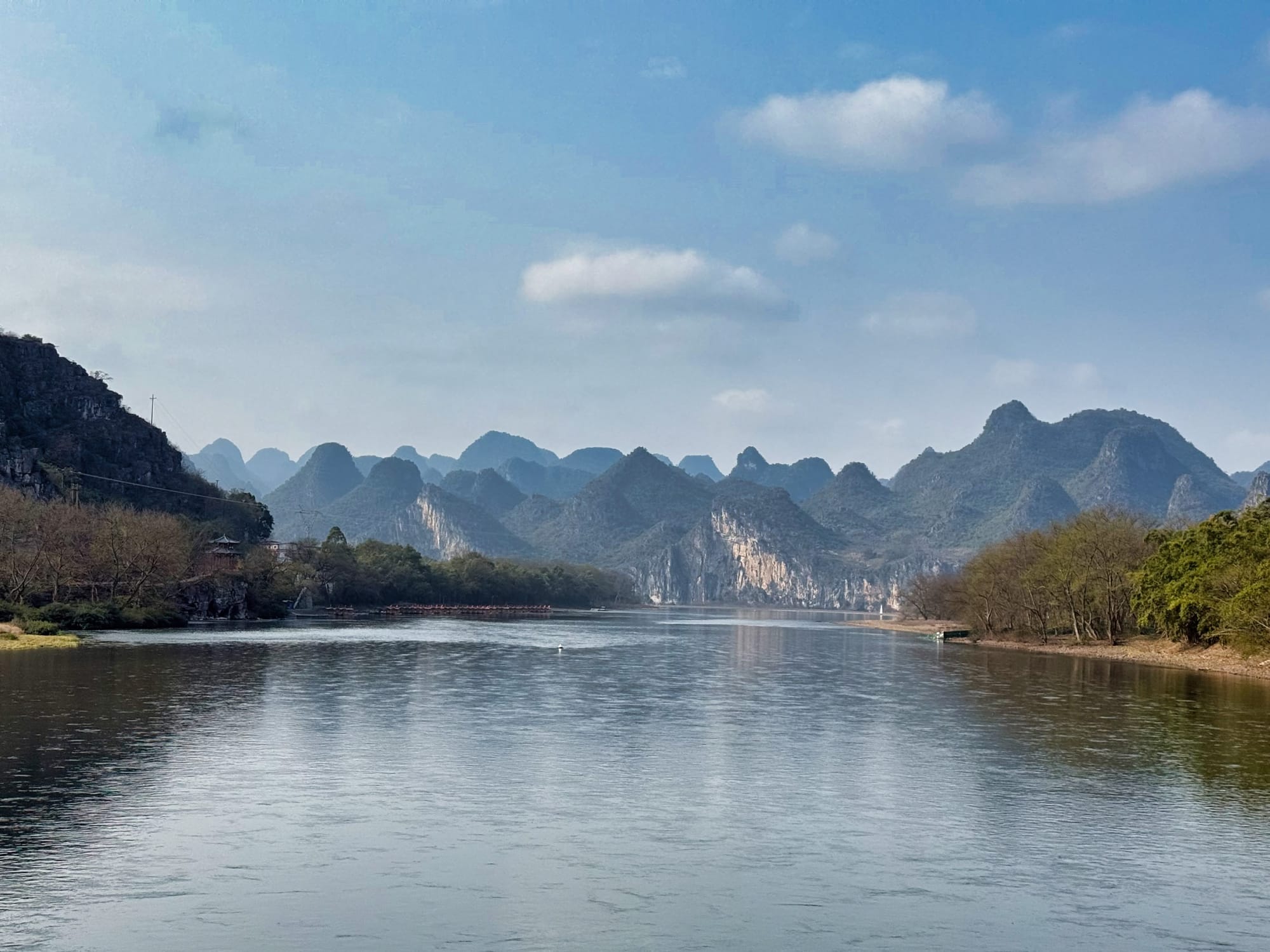
Yangshuo is smaller, quieter, and built around the same karst scenery but at ground level. You can bike between them. You can kayak past them. You can stand next to one and look up and feel appropriately small.
We spent three nights, which was right.
The street market was the kind of thing that reminds you why you travel. Not a tourist market: a real one, set up along the street without much separation between the stalls and the traffic. Every fruit and vegetable you can think of, and several you can't. Fish in buckets. Little eels. Things that were very recently alive and were making that status ambiguous.
People buying actual food for actual meals, which is the best kind of market.
That's where the citrus found me.
I'd been buying fruit in gourmet markets in Shenzhen, paying real money for things that looked good and tasted like they'd given up. Then I stumbled onto oranges at a street stall in Yangshuo and everything changed. Whatever is happening with citrus in this part of China (higher sugar content, soil, climate, the fact that it hasn't been sitting in a refrigerated container for three weeks) the result is fruit that tastes the way fruit is supposed to taste and mostly doesn't.
I started buying them on the street every day.
I also nearly paid ten times the asking price for a bag of them, because the digital payment system here takes some getting used to and I got confused mid-transaction. The vendor corrected me before I could complete the mistake. Didn't hesitate, didn't make a thing of it, just pointed at the right number.
A small thing. It shouldn't have moved me as much as it did. But after weeks of drifting through China as a ghost, unseen on the metro and at breakfast and out on the river, one stranger looking at me long enough to keep me from cheating myself landed bigger than it had any right to. That's what the distance does. It makes the rare moment somebody actually sees you feel enormous. The vendor pointed at a number. I walked away oddly grateful for being noticed.
Lijiang
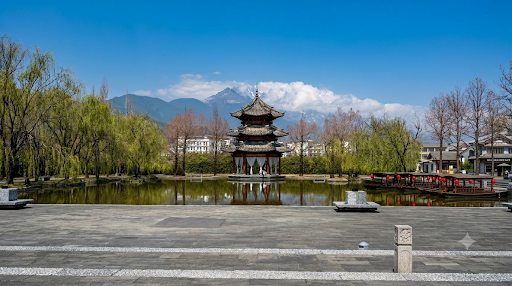
We flew from Yangshuo to Lijiang, which sits in Yunnan province with mountains rising behind it and an ancient city district that has been preserved with the kind of care that makes you suspect someone important decreed it untouchable.
The comparison to Kyoto is accurate and for exactly the same reasons. A protected historic district surrounded by a modern city. Narrow lanes, old architecture, small shops selling things that range from genuinely local to genuinely manufactured for tourists. Costumes available for rental if you want to take selfies in period dress, and plenty of people doing exactly that.
It's organized. It's scenic. It's interesting in the way that well-preserved things are always interesting, which is to say you're glad it exists and you can only wander it so many times before you've seen it.
The mountain backdrop is legitimately impressive. That part isn't touristy—it's just there, behind everything, reminding you where you are geographically.
We ate well. We wandered. We didn't need more than four nights.
Six months into Asia, China lands differently than anywhere else on the continent.
Southeast Asia has warmth and chaos and affordability and a looseness that makes it easy to love. India has depth and friction and beauty and the particular exhaustion of a place that demands your full attention at all times.
China is something else.
Sophisticated. Developed. Smooth in ways that are almost disorienting after months in places where things require negotiation and improvisation. Things just work, not just adequately, but impressively. The technology is ahead. The organization is real. Calling the distance between China and its neighbors a gap undersells it. It's a different category entirely.
But there's a trade buried in all that smoothness, and a month inside it is long enough to feel it. India hands you its people whether you want them or not; the driver, the guide, the man at the next table all pull you in. China hands you everything except that. The country runs flawlessly around you and never once asks you to be part of it. You glide through on rails, paid for with a phone, unbothered and unmet. The warmer, messier places make you a participant. China lets you stay a ghost the entire time, and is too busy building the future to notice you chose otherwise.
It didn't feel like Southeast Asia with more buildings. It felt like its own thing.
We left with more questions than we arrived with, which is usually the sign of somewhere worth returning to. We're already talking about it.
Bangkok—The Sentence I No Longer Have
We came back from China for ten days. Same rhythm: see the kids, don't overstay, get out while everyone still likes each other.
It worked. Everyone was happy to see one another. Nobody reached their expiration date. A success by the standards we've learned to apply.
A person with a history
We found the nomad community again, the meetup we'd stumbled into a month earlier now a pub quiz night with, remarkably, some of the same faces. That's the thing about Bangkok as a hub: people cycle through, but they cycle back. Seeing someone again who you met at a coffee shop a month earlier, in a city neither of you lives in, feels like more than it should. It feels like evidence of something.
Community is one of those words that people who have it don't think about much. When you live in one place, it's just the water you swim in. Friends, neighbors, regulars, the people at the gym who know your name: it accumulates without effort. You don't notice the architecture until you no longer live inside it.
We notice it constantly.
Most of the time we are ghosts. We pass through places for weeks or months and leave without putting down a single root. The relationship that ends up feeling the most consistent is the one with the clerk at the convenience store who sells me cold Diet Coke. That's the honest accounting of what this life costs. You don't invest in people, people don't invest in you, and the world keeps moving.
Which is why these meetups land harder than a few hours in a bar with strangers should. For a few hours, you are not a ghost. You are a person with a history that someone else recognizes, and after months of being scenery in other people's countries, that turns out to be a lot.
The sentence I no longer have
There's a second layer to this that I didn't appreciate until I was sitting across from strangers in a Bangkok coffee shop.
Here's the thing I said I'd come back to. The company I sold on New Year's Eve was the Rosen Institute. Not a full exit (I stayed on as an advisor) but the thing I built, the thing I ran for more than a decade, is no longer mine. Someone else answers for it now. I told you it took months to feel it. This was the day it landed.
What people don't warn you about when you sell something like that is how it messes with the shorthand. For most of my adult life, when a stranger asked what I do, I had a one-sentence answer. Lawyer. Law firm founder. Founder of a company that teaches lawyers. Pick any of them, they all got me past the small-talk threshold and into an actual conversation.
That sentence is gone now. Or at least, it's in quotation marks, past tense, with a footnote.
Sitting at the nomad meetup, introducing ourselves to strangers whose entire measure of us was "these two are in Bangkok, same as us," I realized nobody at the table cared what I used to do. They asked where we'd been. Where we were going. What visa we were on. Not what I did for a living. Because out here, nobody does anything for a living in the way that sentence implies.
That was a strange relief. And a strange loss.
The parallel to the rest of this life is the whole point. We gave up the house. We gave up the neighbors. We gave up the barista. Now I've given up the job title too. That's a lot of structure to dismantle.
Losing the easy answer and finding the new one are not the same sentence. Not even close.
The nomads don't ask. That's the gift. But eventually, someone always asks. And the honest answer now is: I'm figuring that out.
The kid flew out first
Leaving Bangkok this time was different from the others.
Usually the hard part is the goodbye: the awareness of the gap that's about to open, the mental math of when we'll be back. This time we don't have a return trip planned. We're in a minimal-planning phase, deliberately so, and while Thailand is always an option, there's no date on the calendar. That's supposed to feel like freedom. It mostly does. Occasionally it feels like something else.
What made it easier was Lane.
Lane left the day before us, headed to Nepal to hike to Everest Base Camp. The kid flew out ahead of us, which completely changed the emotional geometry of departure. Instead of us leaving them, they left first. Somehow that's better. Don't ask me to explain the math.
My last two lunches in Bangkok were at a Vietnamese place around the corner: bánh mì, the baguette sandwich that France left behind in Southeast Asia like a delicious piece of colonial luggage. Pork, pickled vegetables, cilantro, a swipe of something spicy, all inside bread that has no business being that good this far from Paris.
I didn't realize until we were at the airport that the thread was already starting.
We flew out on a Vietnamese airline, connected through Ho Chi Minh City, then continued on to Paris connecting to Malaga. The baguette in Bangkok. The layover in Vietnam. Landing in France.
The same French bread, following us across the world.
Málaga
A two-bedroom life
We landed in Málaga after six months in Asia almost to the day.
Six months of hotels. Six months of the same geometry: bed, desk, chair, bathroom, repeat. Occasionally a suite. Mostly just a room sized exactly for sleeping and not much else. Lisa on one side of the bed, me on the other, or one of us in the chair pretending it's comfortable.
The Malaga Airbnb has two bedrooms and a living room.
We walked in and just... spread out. Disappeared into separate rooms. Couldn't hear each other. Didn't need to negotiate the chair. It sounds like a small thing. After six months, it is not a small thing.
There's also a washing machine. In the apartment. Available whenever we want it.
I understand this is not an exciting sentence. I'm telling you anyway. When you've been hauling laundry to self-service machines in Shenzhen or paying by the bag on a Thai island, having a washer twelve feet from the bedroom feels like permanence. Like something a person who actually lives somewhere would have.
We don't live here. But for 28 nights, we get to pretend.
The neighborhood is residential in the way that Spanish neighborhoods are residential, which is to say it's also full of shops, restaurants, grocery stores, and people sitting outside at small tables at hours that would confuse most of the world. Kids outside playing. Noise in the building. Neighbors coming and going. The sounds of a place that isn't organized around tourism, even if tourism is nearby.
We're thirty minutes on foot from the tourist center. That's deliberate. Close enough to access everything, far enough to feel like we're not living inside it.
Everyone here is a tourist
Which brings me to something worth saying directly.
There's a strain of thinking in nomad and slow-travel circles that treats tourists as a kind of pollution. Too many of them, everywhere, ruining things. The slow traveler, who stays longer, moves differently, eats locally, positions themselves as something categorically separate. Something better.
It's a bit much.
We are all tourists. Every single one of us who didn't grow up here and doesn't pay taxes here and will leave when our calendar tells us to. The person stuck in traffic complaining about the traffic is the traffic. Staying three months instead of three days doesn't make you a local. It makes you a tourist with a longer lease.
And honestly? Tourists are why Málaga has excellent restaurants. Tourists are why the markets are well-stocked and the services work and the city has investment flowing into it. A less affluent city with tourist attention becomes a city with the infrastructure of a more affluent one. That benefits everyone, including the slow travelers who spend so much energy distinguishing themselves from the people funding the whole thing.
Málaga understood this assignment. It's big enough to have everything you need, small enough to still feel like a place where people know each other. Walking through the neighborhoods you get a community vibe even as a stranger, not because you're part of it, but because it's intact enough that you can feel its edges.
After China and India and Bangkok, that feeling is a full exhale.
Our first real meal was lunch at one of the historic mercados: a covered market with stalls of fruit, meat, cheese, and olives arranged under one roof, and small restaurants tucked around the perimeter like they grew there naturally.
We sat down and ordered without strategy. Ham. Bread with tomato. Cheese. Shrimp.
A tourist who was staying somewhere nearby told us before we left Bangkok that India was hard work and she was tired of working. I knew exactly what she meant, and I knew even then that Málaga was going to be the answer to that.
First meal in. Already right.
Easter, the spectacle
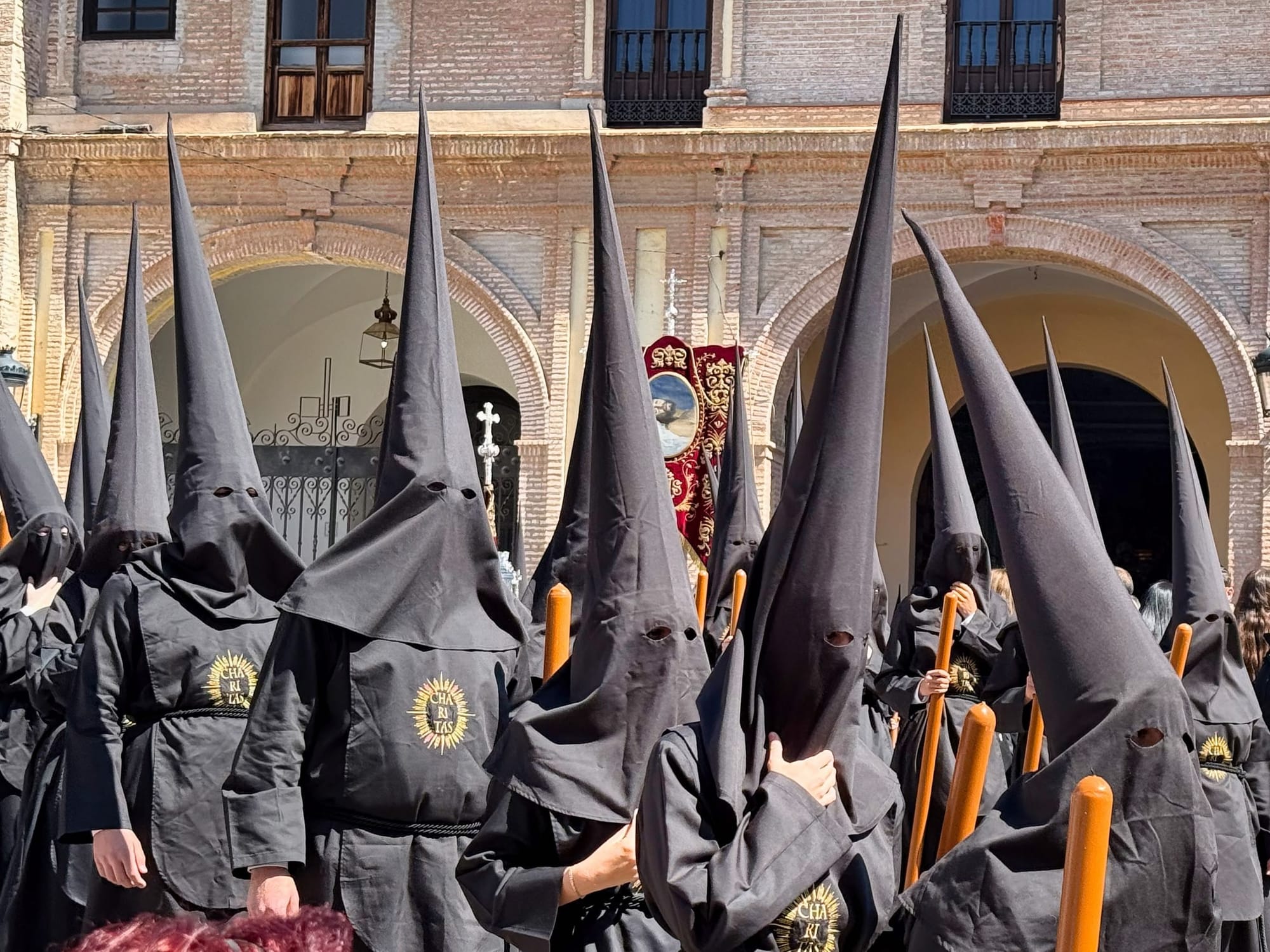
Semana Santa in Málaga is a serious affair—processions that start before sunrise and end after midnight, floats the size of small buildings being carried shoulder-to-shoulder down narrow streets by men in robes. Candles. Drums. Incense. The city commits. You don't watch it so much as you get absorbed into it, stepping aside when a float rounds a corner, ending up in the back of a crowd that wasn't there two minutes ago.
And then Easter ends.
The month of ordinary
The robes get folded back into storage, the floats disappear, the tourists thin out, and Málaga just... is. Normal. Residential. The neighborhood goes back to being a neighborhood. Most days after that were long beach walks, watching cruise ships arrive and disgorge their passengers for a few hours before collecting them again, eating Spanish food at hours that would still confuse most Americans, and not much else.
The back half of Málaga wasn't dramatic. It wasn't a story. It was a month of ordinary, the first ordinary month we'd had in a long time. After six months of Asia (the decibel level of Bangkok, the chaos of Chennai, the jets over Okinawa, the drone light shows of Shenzhen) ordinary was what the nervous system had been asking for.
People-watching at the port. Bakeries in the morning. The ice cream shop downstairs from our apartment, which carried a Rocher-flavored gelato that I became inappropriately loyal to. That was the rhythm. That was the whole thing.
And that's why it worked.
Málaga wasn't the peak of the year. The peak was Corbett, or Hiroshima, or the drone show in Shenzhen, or a dozen other things. Málaga was the recovery.
Twenty-eight nights. We used them all.
Bodrum and Istanbul
We landed in Bodrum after Málaga. We hadn't planned to.
The plan had been Damascus.
Months earlier, on a quiet morning in Okinawa, we booked Syria. Damascus, Aleppo, a handful of day trips. We didn't tell many people. The handful of friends and family who did hear about it just nodded. We've been to enough places that don't make sense to people who live in one place that our closest circle has given up on the explanations.
The window looked open. The arrangements were made. We sat in our hotel on an island that begs for peace, next to an air base that practices the opposite, and booked a trip to the Middle East with the quiet confidence of people who read the news closely.
That was the irony we didn't notice at the time. Okinawa is a place whose museums are dedicated to the proposition that war doesn't solve things and peace is the only acceptable outcome. We booked the trip surrounded by that message. Then we left. And then the world decided to demonstrate how fragile that proposition actually is.
Watching from a safe distance
The news moved slowly at first. Escalation, posturing, familiar patterns. We watched carefully from Asia as we bounced around. We believed we'd be able to make the trip.
Then the US attacked Iran.
Syria wasn't the target. Syria almost never is. But Syria is a neighbor. The Damascus airport closed. Flights canceled. Air traffic rerouted. The country didn't become more dangerous overnight. It became more inaccessible, which is a different thing.
We kept hoping things would resolve. A ceasefire. A reopening. A window.
We'd made a deal with ourselves: if our flight went, we'd be on it. If it didn't, we wouldn't. Simple rule. Binary outcome. We waited.
Then Turkish Air sent us the cancellation notice and refunded our money, and that was the moment we stopped hoping. You can carry hope through a lot. You can't carry it past the refund. Once the airline has walked away, the trip is no longer a trip. It's just a memory of a plan.
Disappointed, and a little relieved
I want to be honest about how this felt, because the honest version is complicated.
Disappointment, yes. Real disappointment. Syria has been on our list for years, and what we were planning—short visit, careful itinerary, knowledgeable guide—depends on a window staying open. This window closed. We're already in conversation with the same agency about a return attempt later this year. They're ready when we are. Whether the country will be is somebody else's call.
But also, underneath the disappointment: relief.
It wasn't the relief of avoiding somewhere dangerous. It was the relief of not having to make the call ourselves. The flight being cancelled took the decision out of our hands. If Turkish Air had kept flying, we'd have spent every day reading the news, weighing the risk, second-guessing the plan. We'd have gone anyway, probably. And we'd have spent the whole trip slightly more alert than a trip should require.
Turkish Air made the call. We didn't have to.
There's a specific kind of in-between that doesn't get talked about much: the space where the decision you couldn't quite make for yourself gets made for you by circumstance. You don't get to feel brave. You don't get to feel cowardly. You just get to feel the thing being taken off the table, and the slow, honest wave of relief underneath the disappointment.
The clock, and the pivot
There was also a clock. Americans get ninety Schengen days out of every hundred and eighty, and Málaga had burned a long stretch of ours. We needed to leave Europe before the calendar forced us out the less pleasant way. Turkey isn't Schengen, and Turkey had always been the staging ground for Syria. With Damascus off the table, Turkey became the trip.
Bodrum
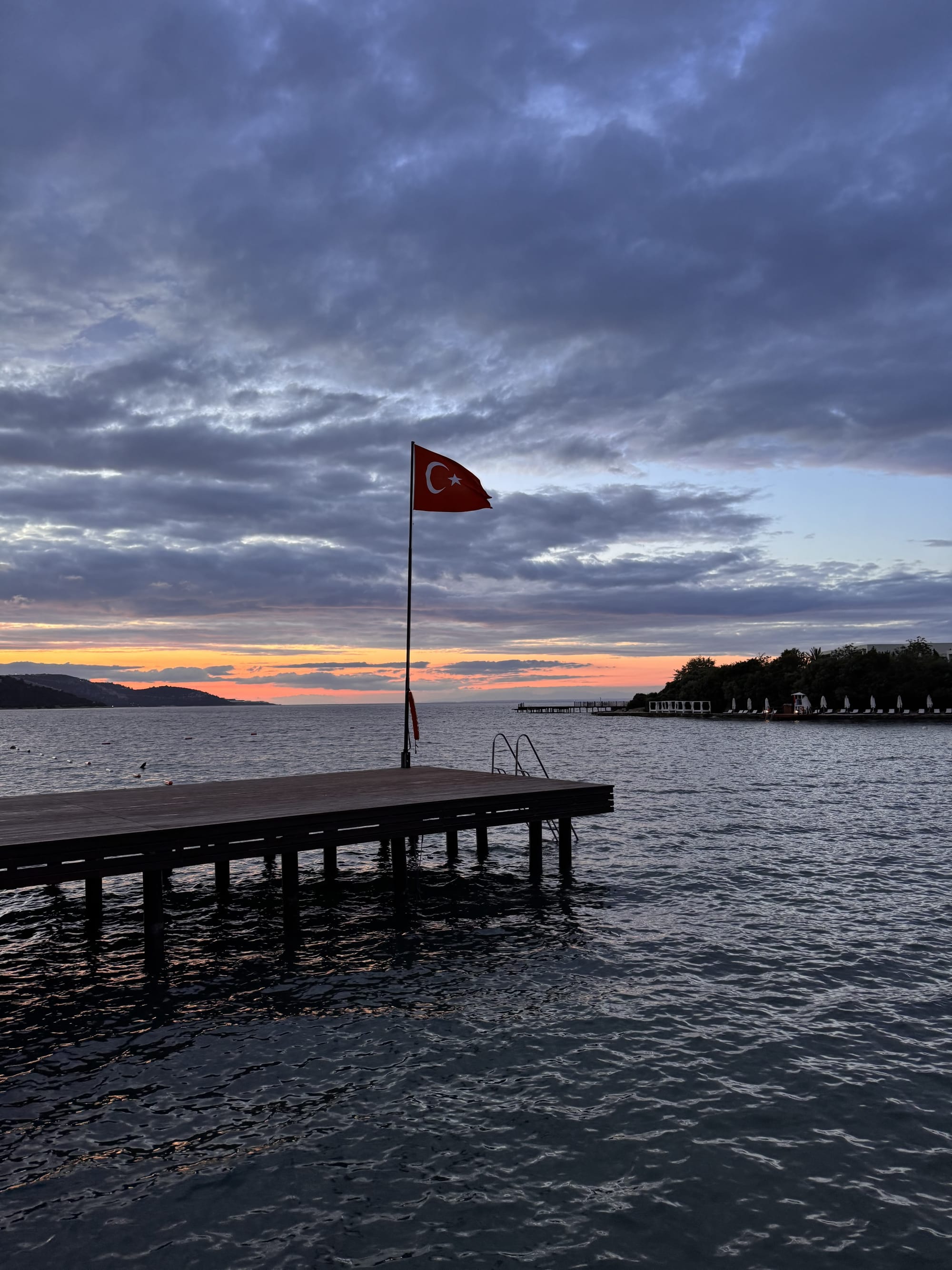
Lisa had wanted to see Bodrum for years. It's the ritzy stretch of Turkish coast: the hundred-million-dollar yachts, the booked-solid summers, the Instagram coverage. We slipped in mid-April, the shoulder of the shoulder season, on a stack of Hilton credits that needed burning, at an all-inclusive resort we mostly didn't leave. When we did, the city itself was pleasant and walkable, the fort and its museum worth the trip; the yacht end of the bay was a mile of luxury-brand construction easy to skip unless you're shopping for a watch the size of your wrist.
What stood out about Turkey wasn't Bodrum. It was the prices. Inflation has done real damage, and we were paying EU-capital prices for ordinary meals. As tourists that's an annoyance; for the people who live here it's something worse, a thread of weariness in conversations with shopkeepers that wasn't there on earlier visits. Turkey is still wonderful but prices, for tourists and for locals, are way up.
Istanbul, the sixth time
This is the sixth time we've been in Istanbul, and somewhere along the way it crossed a threshold, the one where arriving feels less like a new destination and more like coming back to a place that isn't ours. Galata, the same handful of restaurants, baklava on the right corner. We arrived in time for May Day, which here means fences, closed roads, and police with riot shields at intersections we usually walk through without thinking. We walked around the cordons, ate where we always eat, and barely registered it.
The visit was unremarkable, and that's what made it good. We didn't push to see new things. After six visits, a city stops being a destination and starts being a place you happen to be. That isn't a letdown. It's the reward for coming back enough times.
San Sebastián, Spain
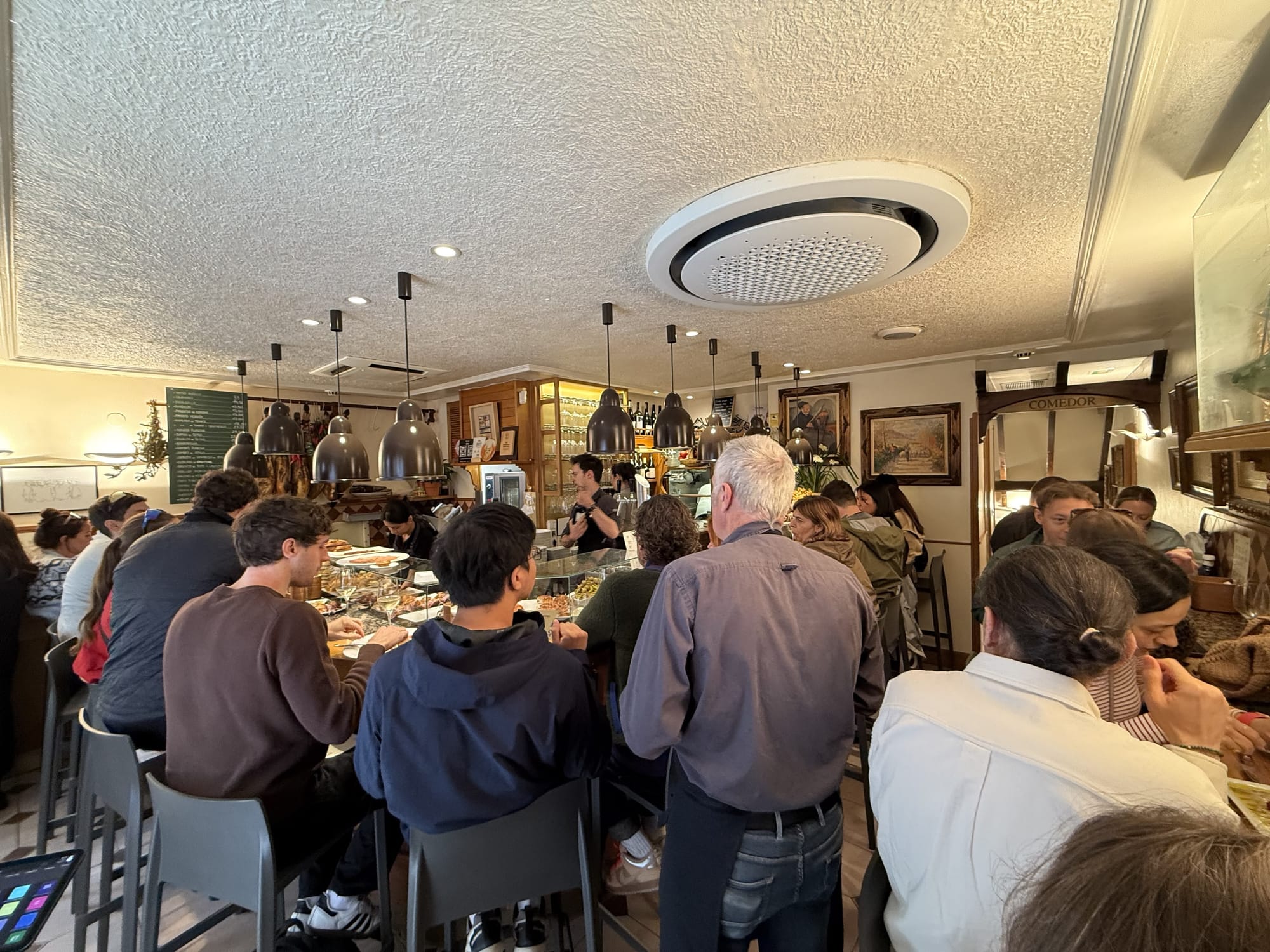
The first place was famous, but the line was too long. The second place was highly rated, but we couldn't find it. The third place was just there—picked because it was right in front of us. It was the best lunch we'd had in months.
San Sebastián is more affluent than most Spanish cities we've visited. Certainly more affluent than Málaga. That matters. A customer base that can afford to demand excellence, and has done so long enough to expect it, produces a different kind of restaurant culture than one still working toward it.
So when we walked into a place we'd chosen by accident we got lucky in a way that wasn't really luck.
For years, if someone asked where in the world we'd go just for a meal, the short list had two answers: Beirut and Istanbul. Beirut has fallen off for reasons that have nothing to do with the food. Istanbul is still on it. We just added a third.
The pintxos bars are packed to the gills. All of them. All the time. The play is to keep moving: one or two things at a counter, three doors down, do it again. The crowd is its own attraction. We talked to people from the Netherlands. A young guy from Mexico, in Spain for school, killing a weekend in San Sebastián because of course you do. Irish on a long weekend. Brits, Germans, other Americans. An accidental UN of small plates and cider poured from shoulder height like a performance.
The anchovies were our one defeat. They're on every menu, a centerpiece of the reputation, and Lisa ordered them in a spirit of due diligence. She took one bite; I finished the plate; we agreed that anchovies are not for us.
The pensión got the opposite reaction from us. Three bedrooms in the middle of the old town, run by a guy who spent his mornings in the common space handling reservations and conversation in equal measure, social by default. The Camino del Norte runs straight through the city, and pilgrims rotated through during our two weeks, some with full packs, some using the bag-moving service that lets you walk with just a daypack: the cheaters' version by purist standards, the sensible version by ours.
We don't do enough of this. Most of our year is hotels, clean and anonymous and sealed, functional the way an airport lounge is functional. This was the opposite.
The last five days, the weather turned. Storms rolled in off the Bay of Biscay, big waves against the seawall and sideways rain that made umbrellas pointless. The city is built for it: the pintxos bars and bakeries are indoors, and you can move from one warm room to the next on a route that keeps you mostly dry. We ate well. We waited.
Then Sunday cleared, and we walked out into a city transformed overnight. A women's international cycling stage was running through town, a separate running event alongside it, crowds three and four deep, helicopters televising the race overhead. And underneath all that, San Sebastián going about its regular Sunday: the church crowd in and out of mass, the bar crowd already on their first round, the beach crowd down on the sand watching the surf. Four crowds, one city, all at once. The peloton flashed through, the bells rang, the waves kept rolling in, and the city absorbed it the way it had absorbed five days of storms.
Next thing we knew, we were at the airport.
Paris—The Trip That Got to Finish
We came into Paris through Lyon, where the best meal we found was Lebanese, run through French technique and improved without apology. Somewhere on that leg a small loop I'd been watching for weeks finally closed. I'd flown out of Bangkok eating bánh mì, the baguette France left behind in Vietnam, connected through Ho Chi Minh City, and landed back in France with the same bread trailing me across the world. France gives the loaf to Vietnam; Vietnam hands it back transformed; France turns around and does the same trick to somebody else's cooking and calls it dinner. The bread never stops moving. Neither, it turns out, do we.
The heat had a head start on us by the time we got to Paris.
Five nights, near the Louvre, in a hotel several tiers above what we'd normally book, paid for entirely in free-night certificates we'd been hoarding, which is the only way we'd have justified a room that nice. The air conditioning worked. That sentence shouldn't need saying. In most of Europe, it does.
Low to mid-nineties, day after day. Say what you want about European weather generally being mild. We've now hit a heat wave in this part of the continent often enough that it's stopped being a fluke and started being a pattern. The buildings weren't built for it. The air conditioning, where it exists at all, wasn't built for it either. You feel the gap between the architecture and the climate it's now operating in, every single afternoon.
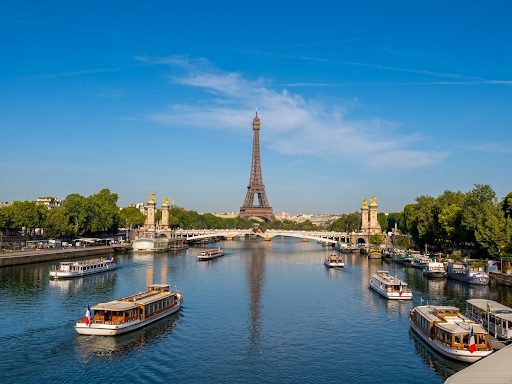
Paris absorbs all of that anyway, because Paris is hard to beat even sweating through your shirt. We didn't fight the heat so much as build the day around dodging it, which is how I ended up eating a cacao sorbet at Berthillon, the shop some people will tell you, with total confidence, makes the best ice cream in the world. Standing at the rail along the Seine, watching the tour boats push past, melting slightly faster than the scoop in my hand.
It might be ninety-four degrees. The ice cream doesn't care. Neither, eventually, do you.
Raleigh—The Annual Maintenance
From Paris, we went where we go every year: Raleigh, for the medical marathon and the family round.
Same shape as always: appointments stacked against each other, portals filling up with results before the doctor who ordered them has even called. This year's addition was a colonoscopy, which I will not pretend to have enjoyed, but which got done and got out of the way inside the two weeks we had. Friends, family, the usual rhythm of a stop that's maintenance rather than vacation, on the body and on the relationships that don't survive on their own without a check-in.
Two weeks. In and out. Then a rush, almost immediately, north.
Montreal
We picked Montreal the way we pick a lot of places, mostly at random. There was a good flight to Copenhagen, where we're headed next for pizza, and Montreal made sense as a step on the way there. Then the flight changed, we rebooked, and the original logic for Montreal evaporated. Montreal stayed on the list anyway. Momentum is its own kind of reason.
At the time we booked it, the bar was low and specific: somewhere different, somewhere we hadn't been, not a place stacked with must-see tourist sites. The plan, to the extent there was one, was to wander and see what happened.
Then people happened instead.
Lisa's mother joined for her first nomad trip. Then two of her nieces. Then her brother. Suddenly we weren't a couple drifting through a city with no itinerary: we were hosting a small delegation that needed things to do, on a schedule, in a place we'd chosen specifically because it didn't come pre-loaded with things to do.
So we did the things. The hop-on-hop-off bus. A light show projected inside Notre-Dame Basilica, color washing over stone built for candlelight. The old town, Chinatown, Tim Hortons. There's a particular irony in assembling a tour-bus checklist for the one city you chose precisely because it didn't need one. We managed. Everyone seemed happy.
People catching up with us on the road is one of our favorite things, and also one of the more quietly stressful ones. You're not just traveling anymore. You're responsible for someone else's good time, in a place you may understand only slightly better than they do, on a schedule you didn't fully control to begin with. My mother has done this with us many times now. We know her rhythms. We know what she needs and what she'll wave off. There's a script.
There was no script for Lisa's mother. This was her first trip with us, ever, after years of watching us do this from the outside. And it landed in the same year Lisa's father died, the loss still close enough that everything around it carries a little more weight than it would have otherwise. So the stakes weren't just "first trip." They were first trip, no husband, daughter living a life that looks nothing like the one she raised her in. We felt that the whole time, even when we were just standing in line for snacks.
It went well. Genuinely well. The relief of that is hard to overstate.
Family is complicated, in the unremarkable way everyone's family is complicated. It's also the thing that matters most, in the unremarkable way everyone eventually figures out. What this life does (the thing people don't always clock from the outside) is put a clock on it. Visible. Ticking. We see my mother in her late eighties and we count the visits instead of assuming there will always be another one. We watched Lisa's mother grieve a husband and understood, in a way you only understand once you've started living far away, that you don't get to choose when the windows close. You just get to notice that they're open, and try to be standing in one when it matters.
This visit mattered. Different from the others. Heavier, in a good way. The kind of heavy that's worth carrying.
The clock runs on the people who stay close to us too, not just the ones we leave behind for months at a time. I think about that constantly now.
Twelve Months In
That clock doesn't only run on the people. It runs on me.
A year of subtracting, and at some point you have to total it up.
One more mirror
There's a mirror in that, too. I've talked about mirrors all through this post—the way liminal space holds one up. There's one I haven't named.
I write these posts with AI help. You've probably figured that out by now. It isn't dictation and it isn't autopilot; it's closer to collaboration. I bring the raw material—voice memos, observations, the things that happened—and the model helps me find the shape. The words are mine. The frame that holds them up was built with a tool.
Yes, including "liminal." I know it's become a tell. Lisa and I were using it years before the machines got hold of it, and it's still the right word, so it stays.
What the tool actually does, when I use it well, is reflect my words back at me with enough shape that I can finally see what I was trying to say. Living this life is strange. The days stack up, the destinations blur, the meaning of it gets slippery. The AI sorts the noise into something I can look at. A mirror, in other words. So was the pen. So was every editor who ever made a writer sound more like himself. I bring the life; the tool helps me see it.
And lately what it keeps reflecting back is smaller than I expected.
The suitcase keeps getting lighter
My suitcase has never been lighter. Right at or under ten kilos most of the time. Light enough now that I don't have to distract the gate agent when we board. I don't know where the things went. Every year there's less in the bag than the year before, and I couldn't tell you which items left or when.
You sell the business. You give up the house. You leave behind the vet and the barista and the dentist who remembered your name. You pack lighter. You drift further. And at some point you realize you've been subtracting from the wrong side of the equation. You thought you were subtracting from the stuff. You were subtracting from yourself.
The question the year opened with was what happens to a person who keeps dismantling the community of service and familiarity he built his life on.
The honest answer is that you get smaller.
Not in any way that earns a lesson. You take up less room in your own accounting of yourself every year, and the bag gets lighter to match.
That's not the answer I was hoping for when I wrote the opening. It might be the only honest one I have.
Lisa and I will keep going. The suitcase will probably get lighter. The list of things I can't do without will probably get shorter. The answer to "what do you do?" will probably stay in quotation marks for a while longer.
We're in the back seat of the Uber. We're at the gate. We're in the hallway of a hotel, trying to remember which room is ours this week.
Not quite here. Not quite there.
Still moving.
See you in a year.
This Series
- 11 Years as a Digital Nomad Lawyer
- 2025 - Ten Years. Still Making It Up. Still Not Going Back.
- 2024 - The Last Cheap Year. We Didn't Waste It.
- 2023 - Eight Years In, We Finally Went Back to Hong Kong and Didn't Fight
- 2022 - Derek Healed. We Picked Up the Pace. The Doors Kept Opening.
- 2021 - We Survived on Covid Tests, Business Class, and Luck
- 2020 - Control Was Always an Illusion. Covid Just Made It Obvious.
- 2019 - After Four Years, Our Biggest Stressor Is Being on Time
- 2018 - Somewhere Along the Way, I Started Feeling at Home
- 2017 - The Gear Doesn't Matter. The Goodbyes Do.
- 2016 - One Year In, and It's Mostly a Blast