The Non-Goodbye
After eleven years of leaving places and people, Lisa and I understand something about goodbyes that most people don't have to think about. They're permanent. We just don't say so.
Before trains, before phones, before any of it, when you rode away from someone, that was the end of the story. No Christmas visit. No text. Just: gone. People understood this. They felt the full weight of it because they had no choice.
Lisa and I do that too.
Not by choice. Not because we're dramatic about it. But structurally, functionally, that's what our goodbyes are.
When we leave a place after three or four weeks, the people we've interacted with every day—the woman at the front desk, the guy at the coffee counter, the owner of the pastry shop I've been at every morning since day two—we're almost certainly never going to see them again. The flight leaves. The chapter closes.
This is fine. This is the deal we made. We know that.
It's still a little bit of a gut punch every time.
The Weight of Thirty Visits
The intensity scales with how embedded you've gotten. If I walk into a café once, order an espresso, and leave, there's nothing to grieve. That's a transaction.
But if I find a good pastry shop on the first day—and I usually do, because I read every review obsessively before I arrive—I go back every single morning. Twenty-five or thirty visits in a month. The person behind the counter starts recognizing me. We develop the world's most limited relationship: I point, they nod, they make the thing, I hand them money, we exchange some version of a smile. Sometimes a few words if there's overlap in language.
That's not a friendship. I wouldn't pretend otherwise.
But it's something.
Ljubljana
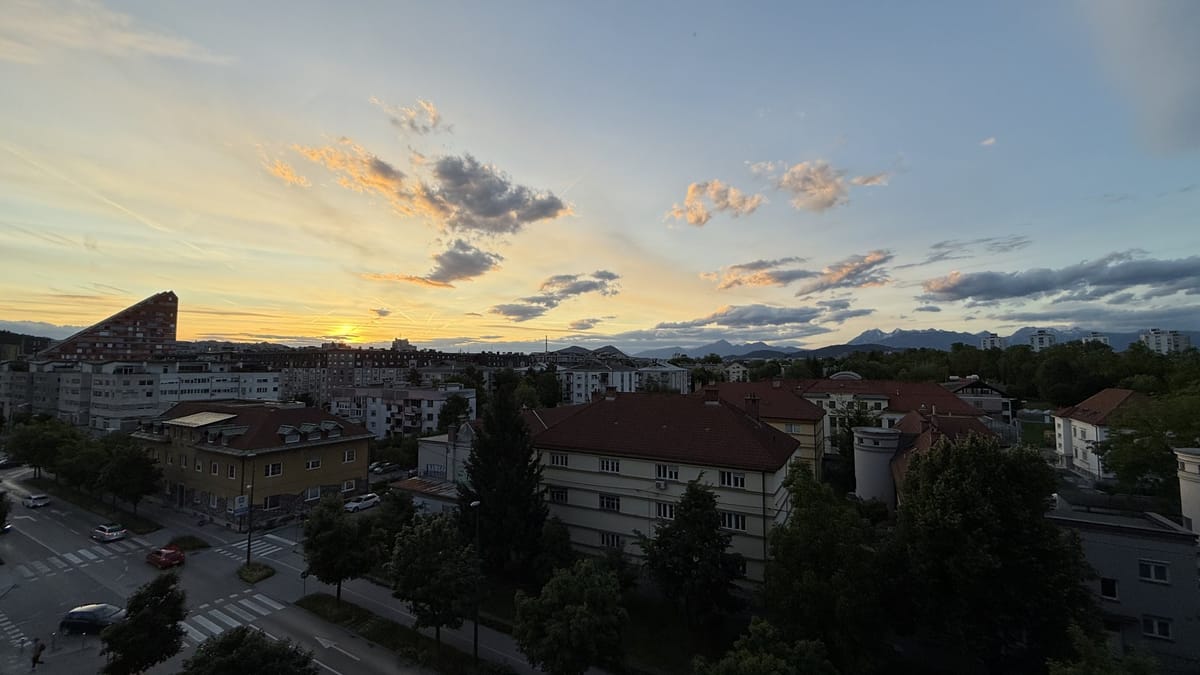
There was a pastry shop in Ljubljana, Slovenia. A Ukrainian couple ran it—refugees from the war, rebuilding in a country that wasn't theirs, making it work anyway. It was the husband who was there every morning. I went every day for the better part of a month.
On the last day, I didn't say anything.
I ordered what I always ordered. He made it. I paid. And instead of saying "see you tomorrow" the way I had every other day, I just—didn't. I walked out.
That night I wrote him a five-star Google Maps review. Specific, useful, the kind that might actually send someone through his door.
I've told myself that was something. I'm not sure I believe it.
There's a particular cruelty to the non-goodbye, and I think it's this: he's a man who understands permanent loss at a scale I can't fathom. He knows what it means when people disappear. And I just—disappeared. One more person who was there every day and then wasn't.
I don't know if he noticed. I don't know if it registered as anything at all. Maybe I was just the American who liked the almond thing.
But I noticed.
The Exceptions
Once in a while, someone makes it back into the story.
There's a hotel in Mũi Né, Vietnam, run by a Vietnamese-American named Van. He and his wife bought the place and run it themselves. We've been back twice. The second time we said goodbye, it was lighter—because it was plausibly not the last time. Van is someone I can say goodbye to. The baker in Ljubljana was someone I should have, more than most—and didn't.
That's the rare version. Most of the time there's no Van. No second visit, no arranged reunion, no "next time we're in the area." Just the one goodbye that isn't quite a goodbye.
What This Costs
I don't know how Lisa processes this. It's not something we talk about much. Maybe she's better at it than I am, or has a cleaner way of compartmentalizing. Maybe she feels exactly the same and we've both agreed by silence not to make it a whole thing. Which would mean the non-goodbye isn't just something I do with strangers. It's a habit.
What I know is that the losses are too small to require attention. Nobody's going to ask how I'm doing about the pastry shop in Ljubljana. I'm not going to bring it up. There's no threshold of grief that gets crossed, no event worth naming.
And yet it's there. A small hole, repeated across twelve years and a hundred and twenty countries. The cumulative weight of a thousand contracts that only one party knew they were signing.