Just Because You're Paranoid Doesn't Mean the ATM Is Safe
The readers who were nervous about ATM cards weren't wrong. But they might be nervous for the wrong reasons. Here's the full breakdown — what the law covers, what it doesn't, and why the world is making this less relevant anyway.
The Pomelo Problem
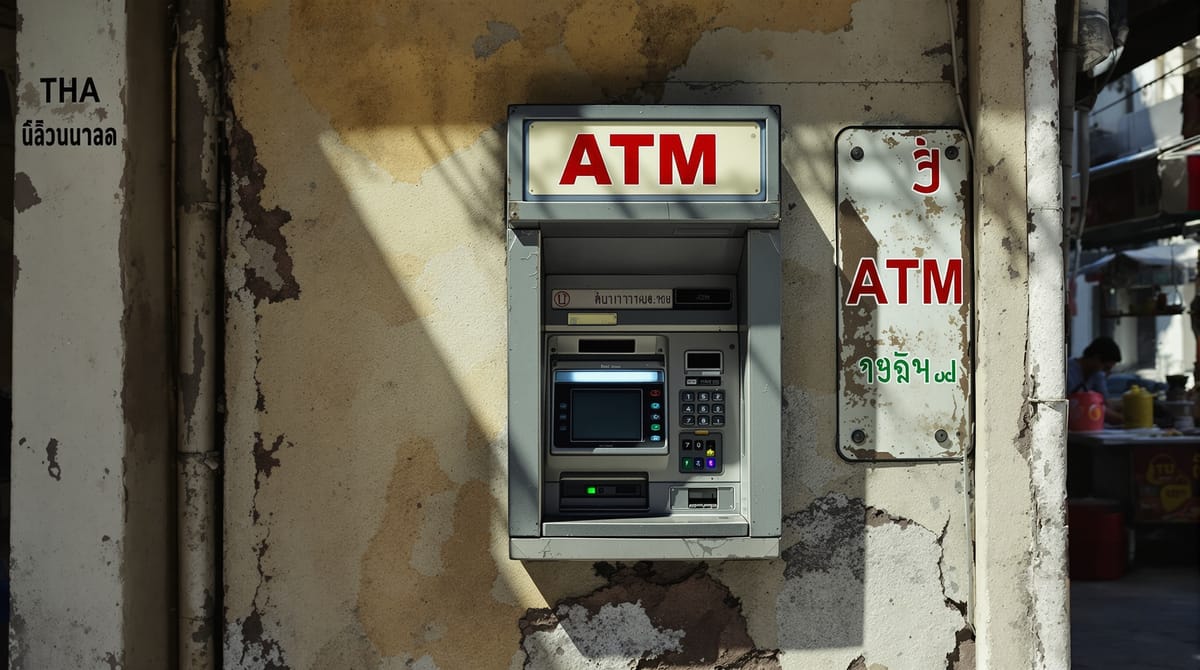
The woman selling pomelo slices on a side street in Bangkok only took cash. I wanted the pomelo. The nearest ATM was down a block I wouldn't recommend after dark, but it was noon and the machine was right there. My first read was that it had no power—it looked dead, dusty, the kind of machine that might have been abandoned mid-lease. Then I saw a light blinking at the card slot. It was on.
I put my card in.
The screen came to life, I got my cash, I got my pomelo, and eleven years and roughly 120 countries later, I have never once been skimmed.
I started noticing comments and questions from readers—in the Facebook group, in email—about ATM cards. A low murmur of worry: is it safe to travel with a debit card linked to your main account? Won't a skimmer drain everything while you're twelve time zones away? I was a little surprised by the volume of it. So I went digging, because when enough people are worried about the same thing, they're usually sensing something real even if they can't name it precisely. What they're often missing isn't the instinct—it's the map.
Here's the map. And a note before we go further: everything that follows applies to US-issued cards and US banking customers. Global laws on this vary dramatically—sometimes stronger, sometimes weaker, occasionally nonexistent. If you bank elsewhere, verify your own country's framework before drawing comfort from any of this.
Two Kinds of Risk
ATM anxiety tends to be diffuse—a general unease about the card, the machine, the unknown. It's worth separating it into two categories, because the law treats them completely differently.
Electronic risk is what most people picture: a skimmer captures your card data and PIN, the thief clones your card, withdrawals start appearing. You're never approached. Nothing physical happens to you. This is the scenario federal law was built to address, and it addresses it well.
Physical risk is different: someone follows you from the machine and grabs your cash, watches your PIN and then your card, or in the most extreme version, forces you to make a withdrawal. No federal statute protects you here. The money you hand over or have taken is gone. Regulation E covers electronic fund transfers—not transactions you authorize, even under duress.
Most ATM precaution advice conflates these two categories, which is why it's so often pointed at the wrong problem. Wiggling the card slot is a response to electronic risk. Knowing where you are, who's nearby, and keeping your daily withdrawal limit low is a response to physical risk. They require different thinking.
The Law That Governs Electronic Risk
The Electronic Fund Transfer Act, implemented as Regulation E, is the federal statute that governs what happens when your card is skimmed. It is not a bank policy. It cannot be revised in an account agreement update. Congress would have to change it.
Here's how it works.
Step 1: The Fraud Happens
Cash leaves your account. You don't know yet.
Step 2: You Notice—And the Clock Starts at Discovery
The most important thing to understand about Regulation E is when your liability clock starts. Not when the fraud happens. Not when the thief clones your card. Not when the first unauthorized withdrawal hits your account.
The clock starts when you learn of the loss or theft.
Here's what that means in practice:
A skimmer captures your card data on a Tuesday. You have no idea. The thief waits a week, then starts making withdrawals. You're traveling, you're busy, you don't check your accounts for ten days. On day eleven you open your bank app over breakfast and see four withdrawals you didn't make.
Day eleven is when your two-business-day clock starts. Not day one when the skimmer hit. Not day seven when the withdrawals began. You have two business days from this morning to report it and cap your liability at $50.
The Federal Reserve's official commentary on 12 CFR § 1005.6 is explicit: the tier-one period begins when the consumer learns of the loss or theft of the access device.
Two scenarios worth distinguishing:
Scenario A—You don't know: Card was skimmed, money is leaving, you have no idea. Clock starts at discovery. Almost certainly in the $50 tier.
Scenario B—You know and you wait: You lose your card in Chiang Mai on Monday. You know it's gone. You decide to deal with it Thursday. Withdrawals happen Tuesday and Wednesday. Clock ran from Monday—the moment you knew—and the delay pushes you to the $500 tier.
Step 3: The Liability Tiers
Regulation E has three tiers, each triggered differently:
Tier 1—$50 maximum: Report within 2 business days of learning your card was lost or stolen. This is where almost every skimming victim lands—you had no idea, you spotted it, you reported it.
Tier 2—$500 maximum: You knew your card was lost or stolen and waited more than 2 business days to report. The $500 cap covers the unauthorized transfers that occurred during that delay.
Tier 3—Unlimited liability: You received a bank statement showing unauthorized transfers and failed to report within 60 calendar days of that statement being sent. The unlimited exposure applies only to transfers that occur after that 60-day window closes—not to transfers that appeared on the statement itself.
The catastrophic scenario requires you to receive a statement showing fraud, not open it for two months, and have additional fraud pile up after that window closes. That is not a trap for attentive people.
Step 4: Your Card May Already Cover You for Zero
Check the back of your debit card. There's a Visa or Mastercard logo.
If it's Mastercard: their voluntary Zero Liability policy covers ATM transactions explicitly. Report promptly, demonstrate reasonable care, your liability is zero.
If it's Visa: their voluntary Zero Liability policy excludes ATM transactions and PIN-based transactions not processed through Visa's own network. At an ATM, Visa's zero liability marketing doesn't apply. You fall back to Regulation E.
One logo means zero. The other means $50. Worth checking before you travel.
Regulation E is the statutory floor underneath both. Network policies are voluntary. The statute is not.
Step 5: You Call Your Bank
No police report required. No need to be back in the US. Call the number on the back of your card or use the app. Follow up in writing—secure message or email—to create a record. Your bank is now on a legal clock.
Step 6: The Bank Investigates and Provisionally Credits You
Under Regulation E § 1005.11, your bank has 10 business days to complete its investigation. If it needs more time, it must provisionally credit your account in full while the investigation continues. For foreign-initiated transactions—every ATM withdrawal you make abroad—the bank's investigation window stretches from 45 to 90 calendar days. But provisional credit is still required within the usual 10 business days, so even during a long investigation, you have your money back.
When fraud is confirmed, the bank must correct the error within one business day of that determination.
Step 7: You Get Your Money Back
Maximum confirmed loss: $50 under Regulation E, or zero if your card runs on Mastercard's network. Federal statutory requirements—not bank policies, not network marketing.
What About Forced Withdrawals?
This is where the two categories split completely, and where the real danger lives.
If someone forces you to make a withdrawal, Regulation E doesn't help. You authorized the transaction—under duress, but authorized. Your bank may show discretion when you report it, but there's no federal floor, no $50 cap, no provisional credit process. That money is likely gone.
The practical response is structural: set a daily ATM withdrawal limit in your bank's app. Most banks allow this. A $200 or $300 daily cap limits what's available even if the worst happens.
But here's the scenario that actually keeps me up at night, and it has nothing to do with skimmers.
You're somewhere unfamiliar. You need cash. The machine declines your card—wrong network, daily limit already hit, bank flagged the foreign transaction, who knows. You try again. You try a different PIN sequence because your hands are shaking and you're not sure you entered it right. Nothing. You're standing at a machine that doesn't work, visibly frustrated, visibly foreign, visibly carrying nothing of value yet—and someone has been watching you the whole time.
The money in that scenario is probably zero because the machine won't give it to you anyway. The danger is entirely real.
The mitigation isn't legal—it's behavioral: know before you go which ATM networks work in the country you're visiting, have a backup card on a different network, and if a machine isn't working, don't stand there trying. Walk away. Find a bank branch. Come back with a plan.
This risk is not evenly distributed. It concentrates in specific places and specific situations, most of which experienced travelers learn to read. In eleven years I haven't come close—not because I'm lucky, but because the places where it happens are knowable.
Meanwhile, the threat that's gotten more efficient is the phone snatch. Fast, low-confrontation, increasingly common in cities that used to feel safe. No ATM involved. No Regulation E. Just a moped and bad timing. Worth more of your situational awareness than the card slot inspection ritual ever was.
The Precaution Trap
The standard advice is to inspect every ATM before you use it: wiggle the card slot for overlays, look for a camera bubble, press on the keypad to feel if it's raised. This addresses electronic risk. But modern skimmers are manufactured to fit specific machine models—they don't wiggle, they don't look wrong, and a traveler with thirty seconds and no baseline cannot reliably detect a well-made one by feel.
What the inspection ritual actually does is keep you focused on the hardware while not watching who's nearby. Electronic skimming, the thing you're inspecting against, has a $50 federal cap and a law behind it. Physical theft of the cash in your hand has neither.
Cash stolen from you has zero federal protection. Cash taken from your account via a skimmer has $50 maximum exposure—and federal law starts that clock when you discover it, not when the fraud happens. Avoiding ATMs entirely and carrying large cash reserves inverts this protection entirely—lose the cash, it's gone.
The World Is Going Cashless Anyway
Here's the context that changes the scale of all of this.
Lisa and I spent 90 days in the EU recently. We hit an ATM exactly once—for a coin-operated laundry near our hotel, the only vendor in three months that didn't take cards. Turkey: no cash needed. The US: no cash. Bangkok is probably the most cash-forward place we spend significant time, and even there it's specific and bounded: market vendors, BTS Skytrain card top-ups. One or two ATM visits per trip, for known purposes, at machines we choose deliberately.
The risk envelope has shrunk considerably from what it was ten years ago, and it's still shrinking. The anxiety hasn't caught up.
Watching Instead of Reconciling
Lisa carries the Schwab card; I carry Chase, which has Mickey Mouse on it. One reason is network redundancy—occasionally a machine accepts one and not the other. The other reason is that if one card is compromised and frozen during a dispute, the other still works.
Whatever your setup, the protection comes from staying current on transactions. We used to reconcile bank statements—matching entries against a register to catch arithmetic errors. Nobody does that anymore, and nobody needs to. What you do now is watch: open your bank app, a tool like Tiller, or whatever makes it easy to scan recent transactions every couple of days. The goal isn't arithmetic accuracy. It's spotting something that shouldn't be there. That's a much lower bar, and it's what keeps you in Tier 1.
The Schwab card has real money behind it—the brokerage funds the checking account via sweep, so the exposure isn't bounded by a small balance. What bounds it is monitoring speed. A fraudulent withdrawal shows up in my daily review within a day or two, well inside the window. The Chase account is kept at a minimal balance by design. Betterment and Fidelity are at a few thousand dollars specifically because the exposure is capped by what I put there.
If you use a credit card for most purchases and pull ATM cash only when a vendor requires it, you compress the exposure further. Credit card disputes run under Regulation Z—a $50 statutory cap that most issuers waive to zero in practice, no reporting timeline to manage, and it's not your money leaving your account while the dispute is open.
I carry a card with Mickey Mouse on it through airports in thirty countries a year and check my accounts over coffee most mornings. That's the whole system.